Why one copper bottle costs 30 euros and another 60
It is the same element in every case. Where the price difference does sit: measured purity, uncoated copper, food safety, what comes in the box, and what weight actually tells you.
Written and source-checked by the Kopero editors · Updated September 8, 2026

The same raw material, twice the price
Copper water bottles sit somewhere between 25 and 60 euros. It is the same element from the same periodic table in every case, and it often comes from the same city: Moradabad in India, where the copper craft has been at home for generations. So where does that difference go?
Here is the answer, point by point, and at every point what you can check for yourself.
In short
- The purity of the copper is measurable, but almost nobody publishes the measurement.
- A coating on the inside makes a bottle cheaper and cannot be seen in a photo.
- Food safety tests under the European rules are separate from purity and cost money of their own.
- What comes in the box varies a lot: carry bag, felt base, box, manual.
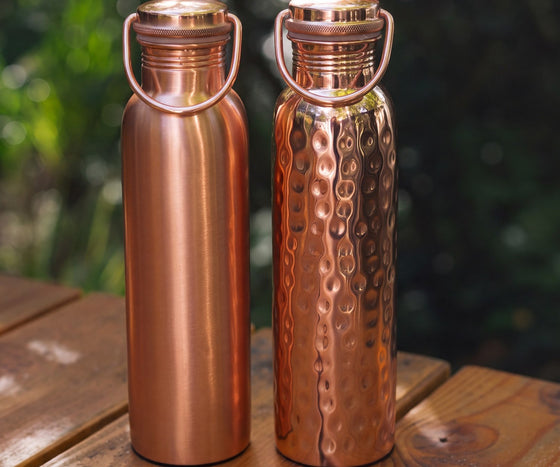
- Weight tells you how much metal is in there. Our 900 ml bottle weighs 300 grams, solid in the hand and light enough to carry all day.
- What you can always do yourself: ask for the test reports.
What is in the material
"Pure copper" is printed on almost every bottle. It is not a protected term, so on its own it says nothing. What makes it measurable is an analysis.
In our case RTC Laboratory in Moradabad did that measurement: 99.21% copper and 0.75% zinc, under ASTM-1621 and IS-228, in a NABL accredited lab. That small share of zinc is not an addition but a trace of the production process; solid copper is not chemically refined to laboratory purity. Exactly what was measured and by whom is in what our copper products are made of.
A measurement like that costs money and time, and as a buyer you see none of it in the photo. That is precisely why many sellers leave it out. How to work something out even without a report is in how to recognise real copper.
The coating you cannot see in a photo
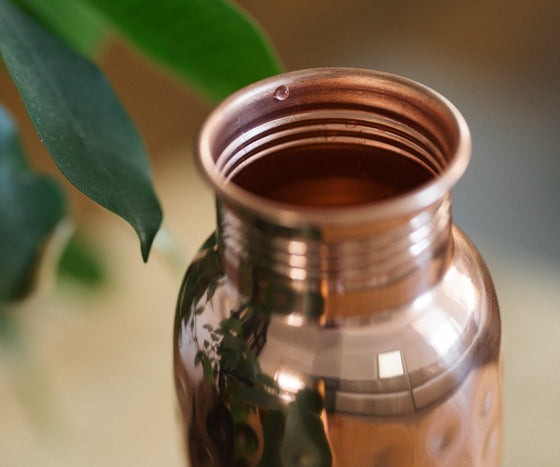
This is the biggest invisible price difference. A lacquer layer on the inside makes a bottle easier to produce and easier to sell, because it keeps shining forever. Only then you are drinking from a copper coloured container instead of from copper.
The nice part is that you notice it by yourself: uncoated copper changes colour. If your bottle goes darker after a few weeks, you have the real thing in your hands. If it keeps its factory shine, something is in between. What that colour change does and does not mean is in why is my copper turning green or black.
The test that has nothing to do with purity
Purity and food safety are two different things, and they are examined separately. URS Products and Testing in Noida held a water bottle, a mug and a pyramid against the European rules for materials in contact with food: EC 1935/2004, EU 10/2011 and REACH. They tested for overall migration, for smell and taste, for nineteen heavy metals and for lead and cadmium in the material itself. Of those nineteen metals, not one was detectable in the water that had been standing in the product.
That is a second report on top of the first, and it is the reason you come across two labs with us instead of none.
What comes in the box
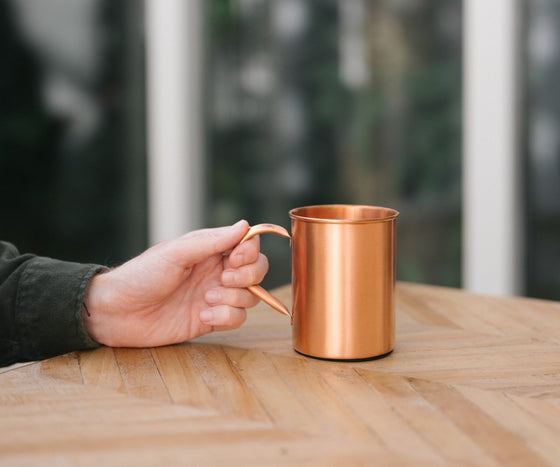
Part of the difference is here, and you see it the moment the parcel is on your table. With us the water bottle comes with a velvet carry bag, a felt base against scratches on your table, a sturdy branded box and a scannable manual. The mug has the same four. The cup has a bag, a box and a manual. The bracelet and the tensor ring come in a luxury jewellery box with a velvet bag alongside, the tongue scraper in a bag with a box.


Not everything has a bag, and that is on purpose: with the jug, the pyramids and the electroculture rods it adds nothing, so a sturdy box goes around them and that is it. What comes with each product is listed on every product page under "In the packaging", so you can add it up before you order.
Details you only see once it is in your hand
The bottle itself carries two things that make daily use nicer. On the cap there is a lever, so you open and close it in one movement and lift the bottle by it as well. Under the base there is a felt layer, which sets the bottle down softly and spares your table top. Both take an extra step to make, and you notice both every day.


Twenty manuals in eight languages
Every product comes with a card carrying a QR code, and it takes you to the manual for exactly your version. Not to a general page about copper, but to the smooth water bottle or the twisted bracelet, with the photos of that piece and the care that belongs to that finish. Twenty variants, eight languages, and we update them when something changes, so your slip of paper does not go stale.

That is exactly the kind of work nobody sees in a product photo and that does sit in the price.
Weight and wall thickness
You will come across bottles sold as an extra heavy version, with a weight quoted alongside. Our 900 ml bottle weighs 300 grams: enough metal to sit solidly in your hand, and light enough to carry all day. That is a choice in wall thickness, and we simply state it.
What weight tells you is how much metal is in there, and so something about sturdiness. What it does not tell you is whether that metal is uncoated, how pure it is and whether it has been held against the food safety rules. That is why the weight and the dimensions are simply on the product page with us, next to the two lab reports, so you can compare all three.
Where the price goes
In summary: two independent lab reports, uncoated copper inside and out, packaging that protects the product rather than merely wrapping it, a manual per variant in eight languages, and handwork from Moradabad instead of a machine line. On top of that comes the copper price itself, which has climbed sharply in recent years: why that happened is in why copper got more expensive.
What it is worth to you is yours to decide. What we do is make it checkable, right down to the report.
What you can check yourself
Ask every seller for the analysis report and for the food safety test. If you get them, you know what you are buying. If you do not get them, you know that too. What else to look at before you order is in comparing copper bottles, and which size suits your day is in which size copper bottle.
Have a look at the copper water bottle, the mug, the cup and the jug, or browse the full Kopero collection.