Cleaning copper: baking soda, vinegar, lemon or citric acid?
Four household remedies and one metal. What works, what damages your copper, and what to do about green deposits on the inside.
Written and source-checked by the Kopero editors · Updated September 5, 2026

Everyone searches for the remedy, not the job
People who want to clean their copper rarely search for "copper care". They search for whatever is in the kitchen cupboard: baking soda, vinegar, lemon, citric acid. So here they are one by one, with what they do and which works best on bare copper.
In short
- Lemon with coarse salt is the method we use ourselves and it works on every Kopero product.
- Citric acid dissolved in lukewarm water does the same and is handy on larger pieces and on relief.
- Vinegar works, but it is more aggressive. Do not soak, rinse immediately.
- Baking soda is mildly abrasive. Fine on hammered copper, careful on smooth.
- Rinsing under the tap matters more than wiping: leftover acid is what actually causes blotches.
- Never: dishwasher, steel wool, scouring pad, bleach or descaler.
Lemon and salt
Cut a lemon in half, sprinkle coarse salt on the cut side and rub over the copper in small circles (not too hard: salt is mildly abrasive and dissolves well in the lemon juice). The acid loosens the oxide layer and the salt abrades just enough to carry it off. Rinse with lukewarm water afterwards and dry immediately and thoroughly.
That last part is not optional. Leftover acid and moisture are exactly what starts the tarnishing again, so a half-dried bottle is dull again within a day. The full routine, including storage, is in caring for a copper bottle.
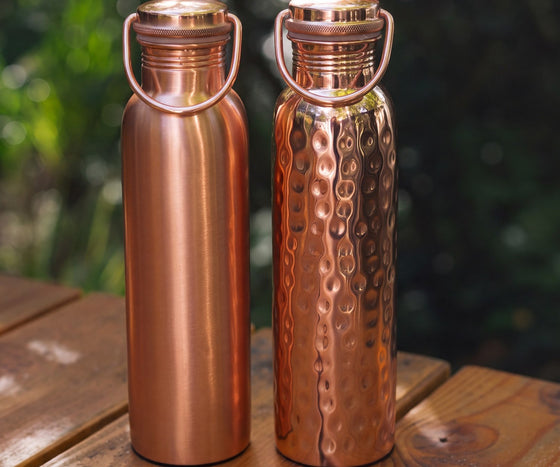
Rinse it, do not wipe it. This is what goes wrong most often, and on hammered and twisted copper it is the difference between even and blotchy. A cloth does not reach into the grooves, so a trace of acid stays there and keeps working on that one spot. Hold the piece under the tap for twenty seconds, turning it as you go, and only dry it completely afterwards. For the same reason, always treat the whole object at once rather than just the spot that bothers you.
The same method works for every product in the range, not just these four.
Citric acid
Citric acid powder is the same acid in concentrated form. Dissolve a teaspoon in a cup of lukewarm water, apply with a soft cloth, leave it for a couple of minutes at most and rinse well.
This is the most practical method for a jug or a large pyramid, where half a lemon has you scrubbing forever. It is also the better choice on a twisted or hammered bracelet: a solution reaches everywhere equally, and on a relief that is what gives an even result. Do not use it undiluted and do not let it dry on: that leaves marks you then have to polish out again.
Vinegar
Vinegar works, which is why it appears on every household list. But it is more aggressive on bare copper than lemon, and the difference is mostly time. A cloth with vinegar, briefly over the surface, rinse and dry: no problem. A bottle soaked in vinegar overnight: that eats at the metal and leaves an uneven, dull surface behind.
If you do want to use vinegar, mix it with a little salt into a paste, work quickly and rinse afterwards. And never put it in the bottle to stand: copper and prolonged acid do not go together, which is exactly why lemon water and soft drinks do not belong in there either. What copper is made for, and what it does for you once it is in there, is in benefits and drawbacks.
Baking soda
Baking soda works differently from the other three: it is not acidic but mildly abrasive. Mixed with a little water into a paste it takes deposits off without using acid.
That difference matters more than it looks. Because baking soda is not acidic, it does smooth the surface and so makes it shinier, but it leaves the oxide layer itself in place. If you polish with soda and end up with more shine and the same blotches, that is exactly what happened: reach for lemon or citric acid as well.
That abrasion is also the risk. On a hammered surface a tiny scratch disappears between the facets; on smooth copper with its continuous reflection it does not. So use a soft cloth and no pressure there, or stick to lemon. What else separates smooth from hammered is in smooth or hammered copper.
And ketchup?
It sounds like a joke, but it is simply the same chemistry: tomato is acidic and contains salt. A layer of ketchup or tomato paste, ten minutes, rinse and dry does the job. Handy when you happen to have no lemon in the house. Do rinse well, because leftover sugar is sticky.
What you never do
No dishwasher: the detergent and the heat attack the surface and leave dull, uneven marks that do not come out. No steel wool or scouring pad: those leave permanent scratches. No bleach and no descaler: too aggressive for bare copper. And no silver or metal polish from a tube unless it explicitly says copper, because most contain substances you do not want in a drinking vessel. Beyond that there is little copper cannot take: it is one of the few materials you can keep touching up for decades instead of replacing.
Green deposits: outside or inside?
Green copper is verdigris and is simply a further stage of the same patina. On the outside it is a matter of taste: leave it or polish it off, both are fine. On the inside of something you drink from, you remove it before refilling, with lemon and salt or citric acid, and rinse well. What discolouration does and does not mean is in why copper turns green or black.
How often does it need doing?
It does not need doing at all. Polishing is for the shine, not for safety: a bottle with patina is no less clean than a gleaming one. Most people do it every few weeks, some never and let the colour deepen. What does count every day is rinsing with warm water and drying immediately, and leaving the bottle open to dry so the inside does not stay damp.
And after that: how it stays shiny
Cleaning brings the shine back. If you want to hold on to it there is one more step: a very thin layer of wax keeps the air off the metal and stretches the shine from days to weeks. How that works, which wax to use and which habits actually make a difference is in how do you keep copper shiny.
Have a look at the copper water bottle, mug, tumbler and jug, or browse the full range.