Smooth or hammered copper: what is the difference?
On almost every Kopero product you choose between smooth and hand-hammered. What changes, what does not, and where is the difference most visible?
Written and source-checked by the Kopero editors · Updated September 5, 2026

The choice you make again on every product
Bottle, mug, tumbler, jug: on almost everything you choose between smooth and hand-hammered. It is the first question most people ask, and the short answer is that it is purely about looks. The longer answer is more interesting.
In short
- The copper is the same in both: 99.21% pure, with no coating and no inner lining.
- Capacity, weight, dimensions and price do not change.
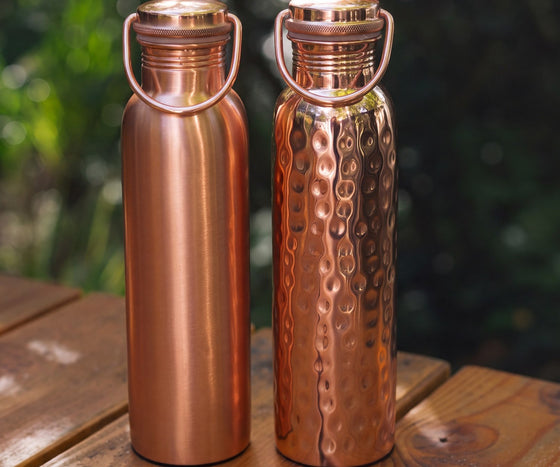
- Smooth gives one continuous reflection; hammered breaks the light up across small facets.
- On the large pieces the difference stands out most, on the small ones least.
- Hammered shows fingerprints and early patina less.
What does not change
The material. Both finishes are solid copper, independently measured at 99.21% purity and tested against the European food-safety standards. No coating, no inner lining, and in the test for nineteen heavy metals not one was detected. What exactly was measured is in what our copper products are made of.
Capacity does not change either. A hammered bottle holds the same 900 millilitres as a smooth one, and the weight is the same. Hammering deforms the surface, not the wall.
What does change
Smooth copper has one continuous, almost mirrored surface. You see the colour of the copper in a single plane, and that makes it calm and timeless. It is the finish that draws the least attention on a table.
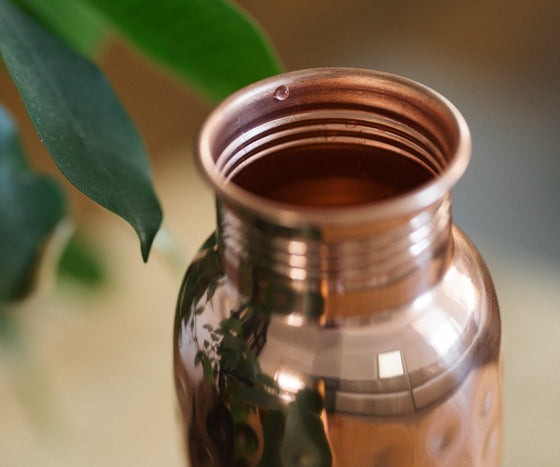
Hammered copper has been worked by hand into a pattern of small facets. Each facet catches the light at a slightly different angle, so the surface comes alive as you turn it. No two pieces are exactly alike, because the pattern is struck by hand.
In the hand, hammered also feels different: a little less slick, with more grip. You notice that most on the bottle, which you pick up more often than the rest.
Where the difference stands out most
On the 1.4 litre jug, by a distance. That is the largest unbroken surface in the range, and it is where the contrast between one continuous reflection and a scattered light pattern is clearest. On the 300 millilitre tumbler the difference stands out least.
If you are still unsure which size you need at all, that is in what size copper bottle.
And the care?
Both ask the same: hand washing, no dishwasher, no acidic drinks, and the occasional polish with lemon and salt (not too hard: salt is mildly abrasive and dissolves well in the lemon juice). The full routine is in caring for a copper bottle.
There is one practical difference. On smooth copper you see fingerprints and the first tarnish sooner, because the surface is one plane. On hammered copper early patina hides between the facets. That does not make hammered cleaner, only more forgiving to the eye. What discolouration does and does not mean is in why copper turns green or black.
The bracelet is a case apart
On the bracelet there are not two but four finishes: twisted, smooth, hammered and round. Twisted has a cable structure of wires wound around one another; round is a smooth round rod with a bead at each end. There too the copper is the same in all four.
Have a look at the bottle, mug, tumbler and jug in both finishes, or browse the full range.