What our copper products are made of
The measured composition of our copper, the laboratory that measured it, and the European food-safety testing behind it. With report numbers, standards, and what was not tested.
Written and source-checked by the Kopero editors · Updated September 4, 2026

You drink from it every morning, or you wear it on your wrist all day. Then you are entitled to know what is in it. Not "high-quality copper", but the number, the lab that measured it and the standard it was tested against.
That is all below. First what our products are made of, then where that copper comes from, then what was tested independently and what came out.
Want to read the results yourself? You can download the test dossier as a PDF (7 pages, English).
In short
- Everything is solid copper, the same material inside and out, with no lacquer or coating.
- Measured composition: 99.21% copper and 0.75% zinc, by a NABL-accredited laboratory.
- Bottle, mug and pyramid were separately tested against the European rules for materials in contact with food.
- Nineteen heavy metals were measured in the water that had been standing in the product. Not one was detectable.
- On odour and taste they scored 0, on a scale where 2.5 is still permitted.
What our products are made of
There is not much to report, and that is exactly the point. Every Kopero product is made of one material: solid copper. No lacquer layer, no coating, no tin lining, no core of something else with a layer of copper over it.
| Component | Share |
|---|---|
| Copper | 99.21% |
| Zinc | 0.75% |
| Remainder | 0.04% |
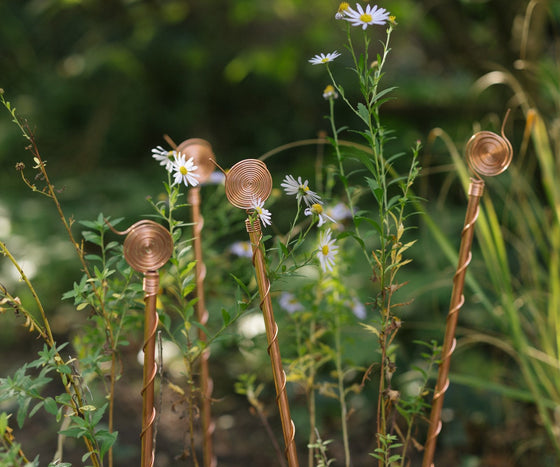
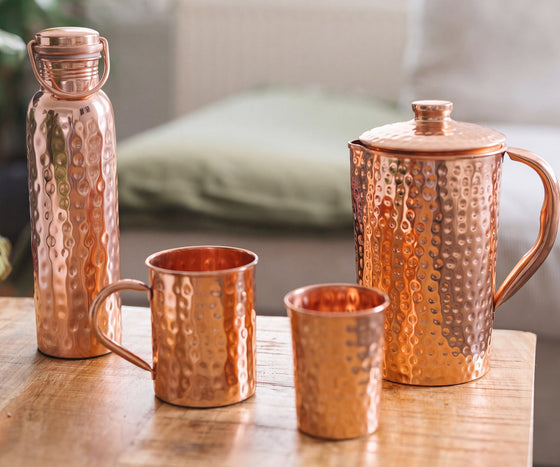
That applies to the water bottle, the cup, the mug, the jug, the bracelet, the tongue scraper, the pyramids, the tensor ring and the electroculture rods. They come from the same workshop and the same material; only the shape differs.
Why that matters only shows after a year. A coated product looks smoother at first, but that layer comes off in time and then you are drinking from something other than you thought. With solid copper there is nothing that can come off. It does change colour, and that is not wear but patina: you polish it away or you leave it be.
Why it is not 100%
Solid copper is not chemically purified to laboratory purity. Production always leaves a trace of another element behind, and in our case that is zinc. So that 0.75% is not something added to cut costs; it belongs to the process. It makes the copper marginally stronger and changes nothing else about how it feels or what it does.
For comparison: brass, which many cheap "copper" products are made of, is 30 to 40% zinc. That is an entirely different material with an entirely different colour. What to look out for when buying copper yourself is in How to recognise real copper.
Where the copper comes from
Our products are made in Moradabad, in the Indian state of Uttar Pradesh. That city is known in India as Peetal Nagri, the copper city, and for good reason: people have worked copper and brass there for centuries, and the craft passes from one generation to the next. The hammer marks on our hammered finishes are set by hand, one at a time.
Exactly who we work with we keep to ourselves, for the same reason most brands do. What we can show is what was measured in the material, and by whom.
What was tested
The composition
RTC Laboratory in Moradabad measured the composition. It is a division of the Metal Handicrafts Service Centre, which falls under India's Ministry of Textiles, and it is NABL-accredited to ISO/IEC 17025:2017 under certificate number TC-6683. Tested to ASTM-1621 and IS-228.
Result: 99.21% copper, 0.75% zinc.
The food safety
The second report comes from URS Products and Testing in Noida, report number URS/LAB/02/RID/26-27/2103, issued on 28 April 2026. A water bottle, a mug and a pyramid were submitted, with Europe as the destination. Four examinations, all with the result "pass":
Overall migration. Tested against EC 1935/2004 and EU 10/2011 with the amendment EU 2020/1245, using method EN 1186-1. The product stands for two hours at 40 degrees with distilled water in it, and that is repeated three times in a row. The limit is 10 milligrams per square inch. For all three products and all three rounds, the result was below the detection limit of 3.
Odour and taste. Under LFGB §30 and 31, method DIN 10955. What is assessed is whether the water that stood in the product smells or tastes of anything. The scale runs from 0 (nothing perceptible) to 4 (strong), and 2.5 is still permitted. All three products scored 0.
Heavy metals that could end up in your drink. Under EN 13130-1, measured by ICP-MS in the water after two hours at 40 degrees. Nineteen elements: arsenic, cadmium, chromium, mercury, lead, aluminium, barium, cobalt, copper, iron, lithium, manganese, zinc, nickel, antimony, europium, gadolinium, lanthanum and terbium. All nineteen came back as "not detected" for all three products and all three measurements, meaning below the measurement threshold.
Lead and cadmium in the material itself. Under entry 63 and entry 23 of Annex XVII of REACH, method IEC 62321-5. Not detectable, in all three products.
That the copper itself was not found in the water deserves a separate note, because it surprises people. At room temperature and in clean water, copper dissolves so slowly that it was not measurable under these test conditions. The trace of copper the Ayurvedic tradition talks about builds up over a whole night, not in two hours.
Which products were in the test
Three products were submitted for the URS testing: the bottle, the mug and the pyramid. The cup, the jug, the bracelet, the tongue scraper, the tensor ring and the electroculture rods were not among them. They are the same material from the same workshop, so there is no reason to expect a different outcome, but there is no separate paperwork for those products. We would rather write that down than act as if everything has been tested.
The reports themselves
The laboratories do not allow their reports to be reproduced or published, so the originals are not shown here. Instead we have made a dossier with the composition, all results, the methods and standards, and the report numbers and dates of both laboratories. That makes every number on this page checkable.
Download the test dossier (PDF, 7 pages, English). If you want a report confirmed, contact the laboratory and quote the report number and date. If you would like to see the originals, email info@kopero.nl; we will check what the laboratories allow.
What these reports show
These reports are about the material: you can safely drink from it and there is nothing in it that does not belong.
The research on copper itself we collect per product in What does research say about copper?. There we note each time what kind of evidence it is, so you can weigh it yourself.
Further reading
Unsure whether something is real copper, even if it is not ours? Then How to recognise real copper gives you tests you can do at home. If your copper is changing colour and you wonder whether that is a problem, Why is my copper turning green or black? explains what is happening.
Want to see how long copper lasts? Copper objects that outlived the centuries covers four finds that are still recognisably copper after thousands of years.
What that material means in practice is in is copper water healthy, and where the price difference between copper bottles comes from is in why one copper bottle costs 30 euros and another 60. Have a look at the copper water bottle and the copper jug, or the full Kopero collection.