How to recognise real copper: the complete buying guide
Not sure if your copper bottle is really copper? Independent laboratories tested the metal thoroughly. Read how, and what you can check yourself.
Written and source-checked by the Kopero editors · Updated August 20, 2026

The question everyone asks before buying
Under almost every video about copper water bottles on Instagram, someone asks: is this actually real copper? It's a fair question. The market is full of sellers who spray a thin layer of copper onto another metal, or who never say how much copper is actually in their alloy. Anyone spending money on a copper bottle wants to know what they're getting.
At Kopero, we don't leave that to chance. The copper we work with comes from Regal Metal World in India and has been independently tested by two specialised laboratories. No marketing text, just certificates with a test number, a method and a result.
In short: how to recognise real copper
- Weight: copper has a density of 8.96 g/cm³, so a genuine copper product feels heavier than its size would suggest.
- Colour: a warm, pinkish-orange glow, no bright yellow and no silvery undertone.
- Magnet test: copper is not magnetic. If a magnet is attracted, there's iron or steel under a coating.
- Wear spots: under any coating there should simply be copper, not another metal.
- Lab certificate for metal composition TC-6683, from RTC Laboratory, according to ASTM-1621:2013 and IS-228.
- Lab certificate for food safety URS/LAB/02/RID/26-27/2103, from URS Products and Testing, against European standards.
Test 1: what's actually in the metal
RTC Laboratory in Moradabad is accredited by NABL, the National Accreditation Board for Testing and Calibration Laboratories, according to the international standard ISO/IEC 17025:2017. That kind of accreditation means the lab itself is periodically checked for the accuracy of its equipment and procedures.
Our water bottle went through a metal composition test at that lab, carried out according to the recognised methods ASTM-1621:2013 and IS-228 (the Indian standard for copper analysis). Result: 99.21% copper and 0.75% zinc. That small remainder of zinc is normal, and even functional. Pure copper (100%) is so soft that it's barely possible to shape it into a sturdy bottle; a minimal amount of zinc gives the metal just enough strength without it becoming a true brass alloy (brass typically contains between 5% and 40% zinc). The certificate carries number TC-6683 and is available on request for inspection.
Test 2: is it safe to drink from
Being pure is one thing. Being safe to drink from every day is another. That's why we also had our water bottle, mug and pyramid tested by URS Products and Testing in Noida, against European food safety rules: Regulation (EC) 1935/2004, Regulation (EU) 10/2011 and (EU) 2020/1245, plus REACH regulation for chemical substances.
Report URS/LAB/02/RID/26-27/2103 contains three key results. The overall migration test, which measures how much substance in total migrates from the material into the water, came back passed. The odour and taste test scored 0 out of 0: the best possible result. And the analysis for nineteen heavy metals, from arsenic and cadmium to lead, mercury, chromium, aluminium and nickel, carried out using ICP-MS, gave the same result for all nineteen: Not Detected.
That means the metal in question, with this extremely sensitive measurement method, was not detectably present. No trace.
What you can check yourself
Not every brand is this transparent, so it's smart to also know what to look out for yourself. Copper is a heavy metal, with a density of 8.96 g/cm³, so a copper bottle feels considerably heavier than you'd expect based on its size. If something feels surprisingly light, there's a good chance you're dealing with a thin coating over aluminium or stainless steel.
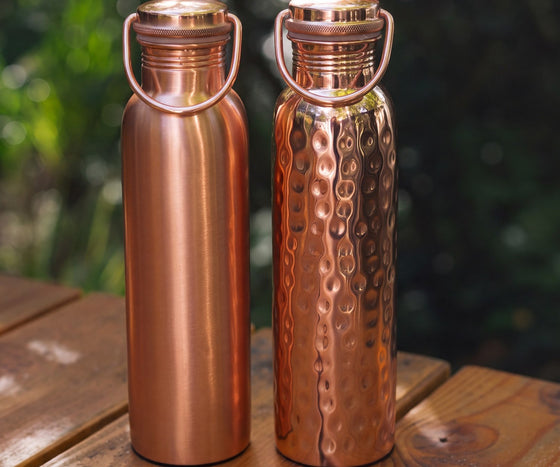
Also look at the colour. Real copper has that characteristic warm, pinkish-orange glow, no bright yellow or silvery undertone. And in places where the surface wears, you should simply see copper underneath any coating, not another metal.
The simplest check of all is the magnet test: copper is not magnetic. Hold a magnet against the surface. If it's attracted, there's iron or steel under the coating.
The same check for the rest of the range
The water bottle is central to this article because you drink directly from it, so food safety is most tangible there. But the tested copper doesn't come from a separate batch reserved only for the bottle. The same alloy also goes into the mug, the cup, the jug, the bracelet, the tensor ring, the pyramid and the garden stakes. If you're unsure about the purity of any other Kopero product besides the bottle, the same checks apply: weight, colour, the magnet test and, on request, the lab certificates.
That also applies to the bracelet, for example. You don't wear it to drink from, but on your wrist, and yet it comes from the same controlled copper source as the bottle. So the same simple checks, weight, colour and the magnet, work just as well if you're unsure about a bracelet, mug, cup or any other product in the range.
What those two reports say and who drew them up is set out point by point in what our copper products are made of.
Combine your own check with the certainty of an independent lab report and you'll know exactly what you're bringing home. That starts with our Kopero Premium Copper Water Bottle and applies just as well to the Kopero Premium Copper Bracelet. Curious about the rest? Browse the full range.