

Lovely long stakes for the vegetable garden

Mark
Verified purchase
SHOP WITH CONFIDENCE 30 days to decide, money back if in doubt
FAST DELIVERY Order before 11:30 pm, usually delivered in 4-5 days


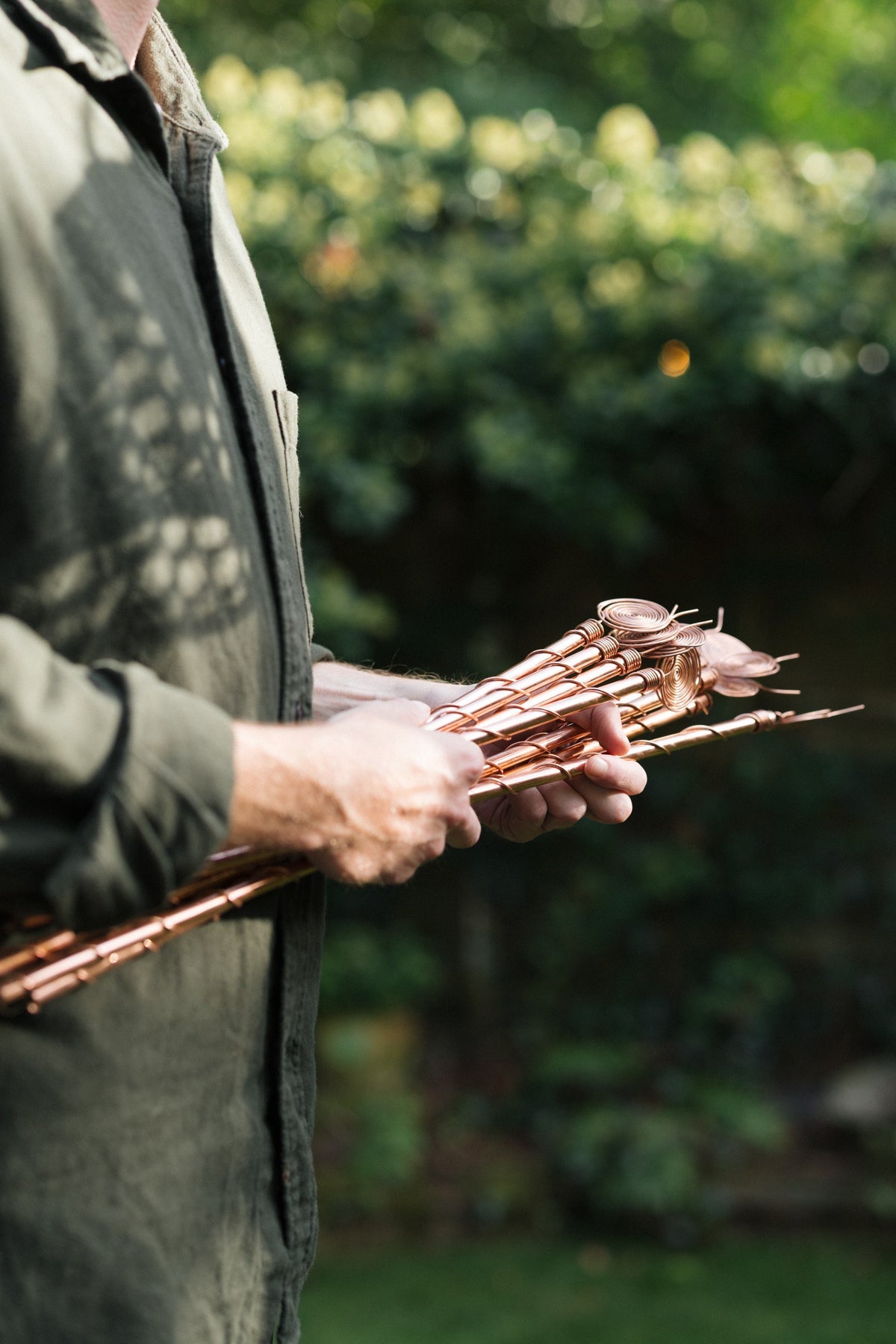
Not just the coil, the stem itself is copper too. No wooden core that can rot.
The shorter size suits pots and smaller plants, the longer one reaches further in a bed or vegetable garden.
Electroculture dates back to 1746 and has since prompted serious follow-up research, from the UK's Ministry of Agriculture to a 2022 study in Nature Food.
The antennas work entirely passively. You push them into the soil and leave them alone all year round.
Solid copper changes colour a little on its own, even outdoors in the garden. That's completely normal, and even a sign of pure copper; it doesn't affect how well it works. How to care for the antennas is in the care guide.

The material is analysed by RTC Laboratory in Moradabad, a NABL-accredited lab, tested to ASTM-1621 and IS-228. In the sample that was analysed the measurement came out at 99.21% copper and 0.75% zinc; the remaining 0.04% falls within the measuring range of the analysis. Food safety is covered by a second report, from URS Products and Testing: tested against EC 1935/2004 and REACH, using the heavy metal limits from EU 10/2011 as the benchmark.


Four copper antennas with a coil on top, which you push upright into the soil beside the plants you have in mind. Nothing else is involved: no power, no batteries, no maintenance. Where the idea comes from and what has been studied about it is in the article on electroculture. The history in the Netherlands itself, from a garden attraction in Andijk to a Philips trial in the Beemster, is in electroculture in the Netherlands.
You choose between 30 and 60 centimetres. The short size suits pots, houseplants and low planting; the long one reaches further into a border or vegetable garden and still stands above taller crops. Four to a set, so you can spread them across a bed or a group of pots. How far apart and how deep is in placing the antennas.
The whole antenna is solid copper, the stake included. That is the difference with versions where only the coil is copper and the stake is wood: wood can rot in the ground, and there is less conductive surface in the soil. Which copper we use is in what our copper products are made of.
That it is copper in particular has the same reason an earth rod is copper: of all metals only silver conducts better, and copper keeps doing so in wet ground for years. The international unit of electrical conductivity is even defined on it. What sits behind that physically is in why copper conducts.
That comparison with the earth rod is not a metaphor. The European lightning protection standard EN-IEC 62305 lists copper as a conductor and as an earth electrode, and what an electrician calls earthing is literally a copper connection to the soil. More on that is in copper as a shield.
Push on the stake when you put the antenna into the ground, not on the coil. It bends easily and should stay round, clear of leaves and mesh. Keep your distance from the roots of the plant itself.
Outdoors copper discolours faster than indoors: rain and soil do their work, and the antennas turn darker and eventually green. That is normal and says nothing about how they work. Why is my copper turning green or black explains when discolouration does mean something.
More has been measured than you would expect. Between 1918 and 1936 the British Ministry of Agriculture reported yield increases of 30 to 50%, in China a programme runs across more than 3,600 hectares of greenhouses with yields 20 to 30% higher, and in 2022 Nature Food published peas that germinated 26.3% faster. We promise no harvest, because that depends on your soil, your crop and your season. Every measurement is laid out in the article above. Measurements were also taken extensively in the Soviet Union, all the way to a greenhouse aboard a space station: electroculture in the Soviet Union and into space. And what insects have to do with electric fields, you can read in can insects sense electricity.
The antennas go into the ground and that is it: no power, no batteries, no upkeep.

Is the spiral on top still round? If it bent in transport, carefully bend it back.

Place it by the plant, on the sunny side and out of the walkway, away from the roots. Indoors: just in the pot.

Press the antenna about 15 to 20 centimetres into the soil, until it stands firm and doesn't tip over. Press on the stem, not on the coil.

The spiral sticks out above the plant, clear of leaves and mesh.

Place them around a bed, in the four corners, or one per pot. No fixed distance is prescribed.

Copper is weatherproof: the antennas can stay outside all year. The green patina is normal.
The packaging also carries a QR code that takes you straight to this guide.
Not copper wire wrapped around a wooden stake, but four complete antennas of solid copper in the size that suits your garden.

This isn't a wooden stake with a bit of copper wire: the entire antenna is made of copper.
The copper spiral forms the distinctive top of every electroculture stake.
The compact size suits pots and small boxes well; 60 cm gives more height in a larger garden setup.
With four stakes you can cover several plants or mark out a defined shape around part of your garden.
You unpack a luxury black branded box. So you can give it away straight from the box, without wrapping anything around it.
A Kopero card is inside the box. The QR code on it takes you to the digital manual.
Antennas, entirely passive
For pot or border
Solid copper right down the stem
Field trials on electroculture
Polish it back, and melting copper down costs it nothing

The 60 cm antenna is the right size for larger beds or taller plants. Same copper coil, but with more reach across the bed.

In the vegetable garden, you place the antennas among the plants you want to treat. Field studies on electroculture have reported yield increases of 20 to 50%.
Unpack it at your own pace, feel the weight and see whether the size suits you. If it is not for you, send it back within thirty days and get your money back. If you use it for longer than you need to judge it, we may deduct for loss of value. You arrange the return yourself with whichever carrier suits you best, or you ask us for a return label. The cost of sending it back is yours.
Read the return policyTranslated from Dutch
Lovely long stakes for the vegetable garden
Lovely stakes for the garden

A fun experiment

Looks lovely!

Good quality stakes. All copper, so they will last a long time

Read about it online. It really works!!

A lovely set. We are going to try it

The rods look good. Fun to experiment with

The little plants seem to grow faster

Beautiful rods, curious to see if they work!

Electroculture is a gardening tradition that dates back to 1746 and has since prompted serious research: the UK's Ministry of Agriculture measured 30 to 50% higher yields in its own field trials between 1918 and 1936, and Nature Food published a 2022 study in which peas under an electric field germinated 26.3% faster and yielded 17.9% more. Results vary by garden, plant and season; the best way to find out is to compare with and without an antenna in your own garden.
The 30 cm antenna is the most practical size for smaller plants, pots and window boxes, indoors or outdoors. The 60 cm antenna is meant for larger beds, vegetable patches and taller plants, and offers more reach. Both are made entirely of solid copper, including the stem, and work in exactly the same way.
Nowhere. The antennas work entirely passively, without power, batteries or maintenance. You push them upright into the soil and leave them be.
Push the antenna in by its stem, not the coil, about 8 to 20 centimetres into the soil depending on its length, until it stands firm and doesn't tip over. Place it by the plant you want to treat, on the sunny side and out of the way of foot traffic, with the coil sticking out freely above the plant and not covered by leaves or netting.
Yes, copper is weather-resistant, so the antennas can stay in the garden all year, including winter. They will discolour over time; that's completely normal and doesn't affect how well they work. Just take them out before digging or mowing. More on caring for them is in the care guide.
For the same reason an earth rod is copper: of all metals only silver conducts better, and copper keeps doing so in wet ground for years. The European lightning protection standard EN-IEC 62305 lists copper as a conductor and as an earth electrode, and what an electrician calls earthing is literally a copper connection to the soil. That is why our antennas are solid copper along their whole length, stake included. More on that is in copper as a shield.


