Can insects sense electricity? What bees, caterpillars, and ticks reveal
From a French idea in 1783 to Bristol's research today: insects turn out to genuinely perceive electric fields.
Written and source-checked by the Kopero editors · Updated September 17, 2026

Ever since the eighteenth century, gardeners have linked electricity to plant health, and to whatever flies and crawls around the garden. Modern research from the University of Bristol shows that this intuition did not come out of nowhere: bees, caterpillars, and ticks genuinely perceive electric fields. Here is what is now known about it.
In short
- Abbe Pierre Bertholon designed a device against wood-boring insects as early as 1783, based on an electrical discharge.
- Bumblebees learn to recognise the electric field of a flower within just a few visits (Science, 2013).
- Caterpillars can feel an approaching wasp coming by its electrical charge, even before they see it (PNAS, 2024).
- Ticks are attracted over a distance of a few millimetres to centimetres by static charge (Current Biology, 2023).
- A passing swarm of bees raises the local electric field by an average of around a hundred volts per metre (iScience, 2022).
An idea from 1783: a device against wood borers
Abbe Pierre Bertholon, the French professor whose book "De l'electricite des vegetaux" (1783) was mentioned earlier in our history of electroculture, designed, alongside his well known mast antenna, a second device: a discharge from a Leyden jar, connected to two iron wires on either side of a tree trunk containing wood-boring insects. For orchards, he envisioned an entire network of wires, so that a single discharge could reach several trees at once. Bertholon was thus, as far as is known, the first to connect electricity and insect control in the garden.
What a bee really feels on a flower
What Bertholon could not have known, and what was only demonstrated in 2013, is that insects genuinely perceive electric fields. Researchers from the University of Bristol, publishing in the journal Science, showed bumblebees artificial flowers with and without a slight electric charge. The bumblebees learned to recognise the difference within just a few visits. Follow-up research by the same group, in PNAS, showed how this works: the fine hairs on a bumblebee's body bend along with an electric field, and that movement is picked up by the nervous system, just as we feel a breeze on our skin.

Caterpillars that feel a wasp coming
Researchers from that same Bristol group published another surprising finding in PNAS in 2024: caterpillars can detect an approaching wasp by its electric charge, even before they see or hear it. Fine, thread-like hairs on the caterpillar's body respond to the field around the wasp, and the caterpillar reacts with defensive behaviour: writhing and biting in the direction of the danger. The same type of hair also proved sensitive to the buzzing field of high-voltage power lines.
Ticks that are attracted over centimetres
In 2023, the same research group described in Current Biology how ticks are attracted by the static charge of an approaching host. In experiments with charged rabbit fur, ticks jumped towards the source of the charge from a distance of just a few millimetres to centimetres, without any physical contact being necessary. It is one of the clearest examples that small arthropods actively use electrical signals from their environment.
A swarm that creates its own field
Insects do not just sense electricity, they also generate it themselves. A research team from the universities of Bristol and Reading measured in 2022, published in iScience, that a passing swarm of honeybees can raise the local electric field by an average of around a hundred volts per metre: the same order of magnitude as the charge you measure in the air when a thunderstorm is approaching. In large swarms, this even rose to several hundred volts per metre.
From Bertholon to the modern vegetable garden
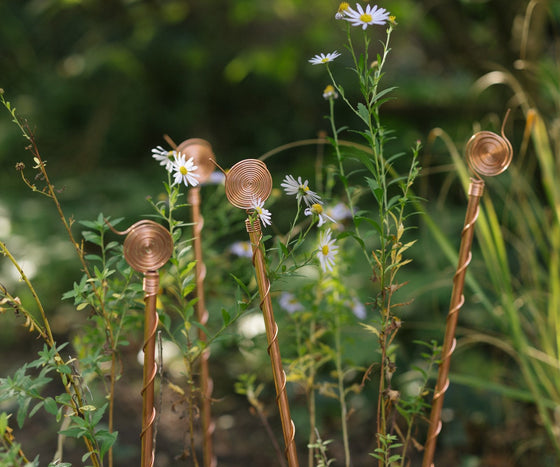
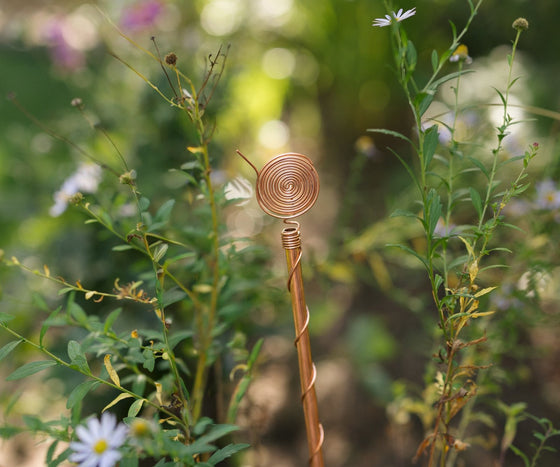
These recent discoveries offer a fascinating new perspective on an old theme. Ever since Bertholon in the eighteenth century, gardeners have linked electricity to plant health, and modern science now shows that the insect world around them is indeed sensitive to electrical signals from the air and the soil. It is precisely these kinds of connections that make electroculture, from Bertholon's Leyden jar to today's copper stakes, such a lastingly appealing subject to experiment with yourself.
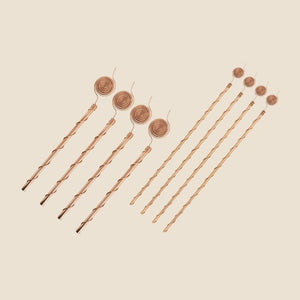
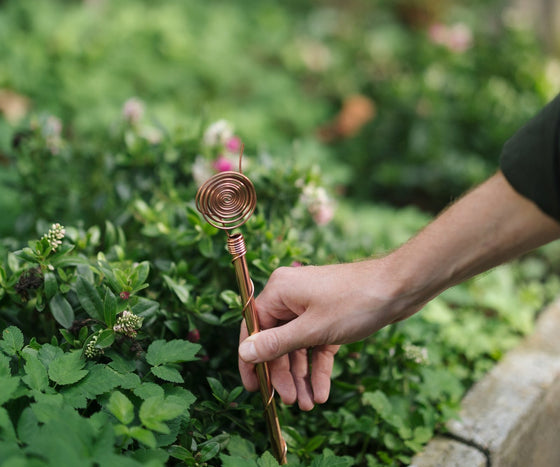
Curious how to try this yourself? The placement guide for electroculture antennas shows where and how deep to place them, and the full history of the idea is covered in electroculture: a centuries-old gardening tradition rediscovered. Check out the copper electroculture stakes to get started yourself.