Electroculture: a centuries-old gardening tradition rediscovered
From Abbé Nollet in 1749 to modern studies: the history of electroculture and electric fields in the garden.
Written and source-checked by the Kopero editors · Updated August 20, 2026

Long before modern fertiliser or laboratory research existed, people were already standing in their gardens with metal rods, curious whether electricity could help their crops grow. Electroculture is a tradition that winds through gardening history for more than two hundred and fifty years, and that tradition is older and better documented than most people think.
In short
- Abbé Pierre Bertholon already described a mast-antenna system, the "électro-végétomètre", in 1783 to channel atmospheric electricity into crops.
- The British Ministry of Agriculture ran official research from 1918 to 1936/37 through its own "Electro-Culture Committee", producing eighteen reports.
- Field trials by that committee showed yield increases of 30 to 50%, and in one trial as much as 118%.
- In 1924, Georges Lakhovsky wound a copper coil around a diseased geranium and claimed recovery within three weeks (patent US1962565A).
- Modern research (Li et al., 2022, Nature Food) showed 26.3% faster germination and 17.9% higher yield in peas.
- A Chinese greenhouse programme covering more than 3,600 hectares reported, after nearly thirty years of research, 20 to 30% higher yields, with 70 to 100% less pesticide use.
- The recent renewed popularity of copper garden antennas is widely attributed to TikTok content, driven by creator Elisa (@gardening521).
Early voices: Nollet and Bertholon
The earliest traces go back to the mid-eighteenth century. Abbé Nollet reported to the French Académie in 1749 that electrified mustard seeds germinated faster than untreated seeds, an isolated but widely cited observation.

The first fully worked-out system didn't appear until a generation later, from a lesser-known name who deserves at least as much attention: Abbé Pierre Bertholon de Saint-Lazare (1741-1800), professor of physics in Montpellier. In his book "De l'électricité des végétaux" (1783), Bertholon described a complete working concept: a mast-antenna structure, which he called the "électro-végétomètre", to capture atmospheric electricity and channel it into crops via conductive masts. Where Nollet reported a single observation, Bertholon delivered a fully worked-out theory complete with apparatus, more than a century before the term electroculture became popular, and decades before Christofleau came up with similar ideas. For that reason, some historians regard Bertholon as the true founder of electroculture as a coherent idea, even though Nollet's observation is chronologically the earlier mention.
Selim Lemström and the Northern Lights
More than a century later, in 1904, Finnish physicist Selim Lemström picked up the thread again. Lemström was fascinated by something he saw in his own country: trees growing surprisingly fast, despite the short growing seasons of the far north. He suspected a link with the Northern Lights and the atmospheric electricity that accompanies them. He worked out that question in his book "Electricity in Agriculture and Horticulture" (1904). In it, he describes higher yields for almost every crop he treated, up to about one and a half times the expected yield.
The British Electro-Culture Committee: official government research
What sometimes wrongly makes electroculture look like a fringe phenomenon is that few people know how seriously it was taken up by official bodies. From 1918 to 1936/37, the British Ministry of Agriculture had its own "Electro-Culture Committee", established under Lord Ernle and chaired by electrical engineer Sir John Snell. Researchers such as botanist Vernon Blackman (Imperial College) and physicist Sir Oliver Lodge contributed to the programme.
The committee eventually published eighteen reports based on years of field trials. The results: yield increases of 30 to 50% were not the exception, and one trial even showed an increase of 118%. For nearly two decades, the British government funded this research into the effects of electricity on agricultural crops: a very different scale from a single individual experimenting in their garden.
Georges Lakhovsky and the copper coil
While the British committee ran large-scale field trials, the French-Russian engineer Georges Lakhovsky (1869-1942) experimented on a smaller scale with an idea close to Kopero's own product: a coil of copper wire. In December 1924, he wound a 30-centimetre copper wire coil around a geranium with a tumour. According to Lakhovsky, the tumour disappeared within three weeks. He had his work recorded in patent US1962565A, which can still be consulted today.

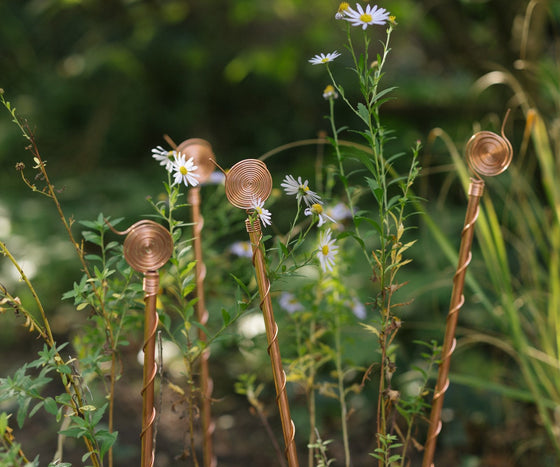
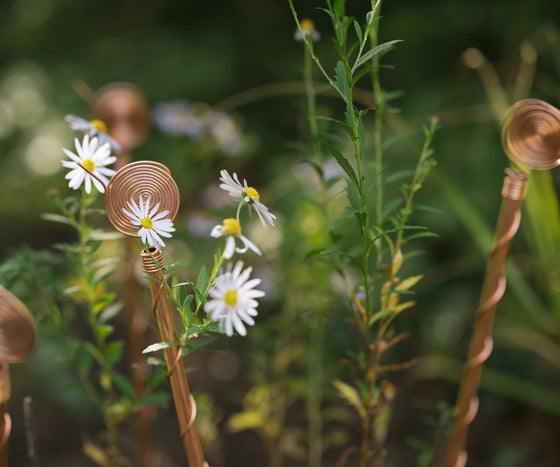
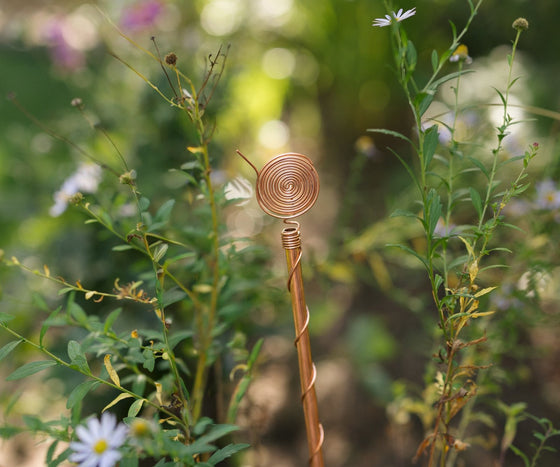
That claim comes from Lakhovsky himself and has never been independently verified. What is true, though, is that the form, copper wire wound into a coil, is exactly the principle you find in today's electroculture garden stakes.
Justin Christofleau and the metal antennas
In 1925, inventor Justin Christofleau published the book "Électroculture" in France. Christofleau claimed that metal antennas and rods, placed in the garden, could increase yield by up to two hundred percent, without any fertiliser involved. He also had his ideas legally recorded: in 1933 he filed patent FR764497A, titled "New electroculture device".

Soviet research: electricity and plant sex
Electrical treatment of crops was also experimented with in the Soviet Union, among other things with hemp. Researchers reported a shift in the ratio between male and female plants: from 20-25% to a considerably larger share of female plants under electrical treatment, a striking finding within an otherwise relatively unknown line of research.
What modern research has shown
In 2022, Li and colleagues published a study in the renowned journal Nature Food. They built a device that generates its own high voltage from wind and rain, and tested it on peas. The result: 26.3 percent faster germination and 17.9 percent higher yield compared with untreated plants.
Even larger in scale is the Chinese electroculture programme. In greenhouses covering a combined total of more than 3,600 hectares, spread across regions with different climates and soil types, researchers hung bare copper wires above the crops. The Chinese Academy of Agricultural Sciences reported, after nearly thirty years of research, 20 to 30 percent higher vegetable yields, with 70 to 100 percent less pesticide use and more than 20 percent less fertiliser. The programme is still growing by hundreds of hectares every year.
A related tradition: Wilhelm Reich
Anyone who digs into electroculture occasionally runs into the name Wilhelm Reich, the same Austrian-American psychoanalyst who also appears in the stories behind Kopero's tensor ring and orgonite. Working in the same era, Reich developed an idea that looks superficially similar to electroculture: his "cloudbuster" was meant to influence invisible atmospheric life force through metal tubes, aimed at affecting weather and cloud formation. That's a different application from electrifying crops, and there's no documented historical link between Reich's work and the electroculture tradition of Nollet, Bertholon, Lemström and Christofleau. His cloudbuster therefore stands apart from the history of electroculture itself: a related, separate tradition from the same period, aimed at invisible atmospheric energy through metal structures.
How to set up a fair garden test yourself
Electroculture is, above all, a tradition to experience rather than just read about. Create two plots, pots or planters that are as identical as possible: the same seed, the same soil, the same amount of light and exactly the same amount of water. Place a copper electroculture stake in one group and leave the other group untouched as a control.
Take a photo from the same spot every week and record the germination date, plant height, number of leaves and, eventually, harvest weight. That's exactly how your garden becomes part of the long experimental line running from Bertholon's 1783 work and Christofleau's electroculture book to contemporary experiments with electric fields. Also note the location, wind direction and weather: when working with earth, atmosphere and form, it's precisely those details that can make the story of your experiment visible.
The modern revival: from garden stake to TikTok
After decades in which electroculture was mostly a footnote in gardening history, interest has grown considerably again in recent years. That renewed popularity is widely attributed to social media, with TikTok creator Elisa (@gardening521) driving the trend around copper garden antennas. Through short videos, she introduced a new generation of gardeners to an idea that, as this story shows, has been around for more than 250 years.
From Nollet's mustard seed and Bertholon's mast-antenna, via an official British government committee and Lakhovsky's copper coil, to Christofleau's patent and a modern high-voltage device powered by wind and rain: electroculture is a tradition that has managed to fascinate generation after generation of gardeners and researchers. Copper, with its exceptional conductivity, has remained the material of choice throughout that entire history. Want to try this centuries-old tradition in your own garden? Check out Kopero's electroculture garden stakes, or discover the full collection of copper products from the same tradition.