From two hundred hectares to a Soviet space station: electroculture without borders
While Europe was still experimenting, electroculture in Russia grew into two hundred hectares, an academic method using buried copper, and even a greenhouse on a space station.
Written and source-checked by the Kopero editors · Updated September 17, 2026

The Netherlands had its Andijk, France had its Christofleau, and England had its Electro-Culture Committee. But nowhere did electroculture grow as much as in Russia and the later Soviet Union: from two hundred hectares in the nineteenth century to a method using buried copper plates, and eventually a greenhouse aboard a space station.
In short
- Jakub Narkiewicz-Jodko expanded his electroculture from 10 to 200 hectares (1891-1897) and won gold with it in Paris in 1899.
- Engineer Kaznakov described in 1896, in Kronstadt, how zinc and copper plates increased the sugar content of beets.
- Aleksandr Chizhevsky improved the germination rate of cucumber seeds by fourteen to sixteen percent in 1932.
- The Timiryazev Agricultural Academy developed a method using buried copper alloy and zinc alloy plates, entirely without a power source.
- Aboard the space stations Salyut-6 and Salyut-7, systems that mimicked the Earth's electric field for crops were in operation from 1976 to 1991.
Narkiewicz-Jodko: from 10 to 200 hectares
While Western Europe was cautiously experimenting in the nineteenth century, estate owner Jakub Narkiewicz-Jodko (1848-1905) immediately set to work on a large scale on his estate Nadniemen, in what is now Belarus. Starting in 1891, he placed metal rods on tall poles, connected via insulated wires to zinc plates of one hundred square centimetres, buried to a depth of about eighty centimetres in the ground. What began as ten hectares in 1891 grew within a few years to two hundred hectares of rye, oats, barley, maize, peas, beans, hops, and fruit. Narkiewicz-Jodko reported a growing season that became three to four weeks shorter and yields up to twenty percent higher, and he gave his first official lecture on the subject on 28 January 1892 in Saint Petersburg. His work was awarded gold in Paris in 1899, and physicists such as Mendeleev spoke favourably of it.

Kaznakov in Kronstadt: copper and zinc side by side
A few years later, in 1896, engineer E.N.I. Kaznakov in Kronstadt described a simpler setup: zinc and copper plates on either side of a plant bed, connected to each other above ground. The small voltage difference between the two metals proved enough for a noticeably higher sugar content in beets, something the Russian encyclopaedia Brockhaus-Efron described at the time as "decisive."
Chizhevsky and the first step towards seed treatment
In 1932, physicist Aleksandr Chizhevsky, known for his research on the sun and biological rhythms, worked at the Central Laboratory for Scientific Research in Kuzminki near Moscow on a different idea: briefly exposing seeds to an electric field just before sowing. With cucumber seeds, he measured a germination rate that improved by fourteen to sixteen percent after fifteen to twenty minutes of treatment. This method was further developed after the Second World War in Chelyabinsk, with machines for large-scale electrical seed treatment.
The Timiryazev Academy: copper in the ground, without power
The most surprising finding in this entire line of research comes from the Timiryazev Agricultural Academy in Moscow, named after botanist Kliment Timiryazev (1843-1920), one of the founders of plant physiology in Russia. Researchers at the academy developed a method that works entirely without a power source: plates of a copper alloy, about 150 to 200 grams per square metre, combined with plates of a zinc, aluminium, magnesium, or iron alloy (approximately 400 grams per square metre, each 40 to 50 by 2 centimetres and 3 millimetres thick), buried ten to thirty centimetres below the topsoil. Exactly as with today's copper garden stakes, there is no battery or power outlet involved here: the metal itself, in the moist soil, is the entire system.
All the way into space
Research into electricity and plant growth continued in the Soviet Union for decades, far beyond what happened elsewhere in Europe. Aboard the space station Salyut-6, a device called "Elektropotentsial" was in operation from 1976 to 1982, mimicking the Earth's natural electric field for crops that would otherwise miss that field. Its successor, Salyut-7, carried a greenhouse called "Oasis-1" from 1982 to 1991, in which the root zone of peas and wheat was stimulated via carbon strips. From a Dutch garden stake to a Soviet space station: the same basic idea, harnessing the Earth's electricity for plant growth, turned up in the most far-flung places.
The same tradition, closer to home
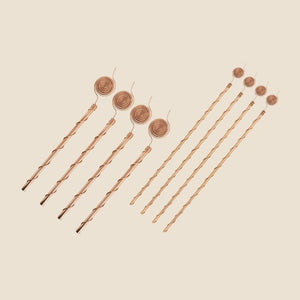
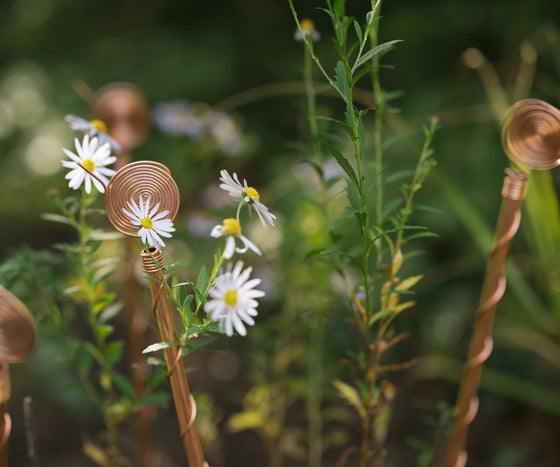
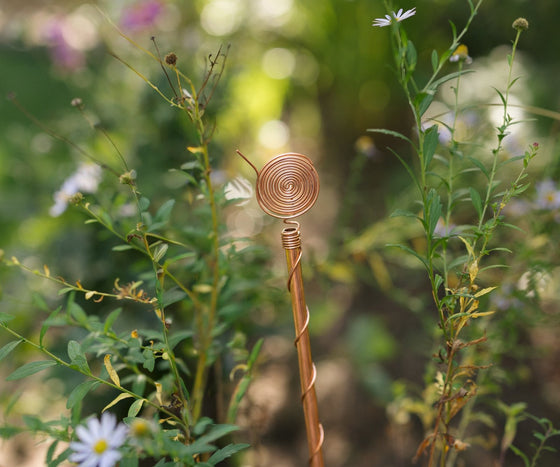
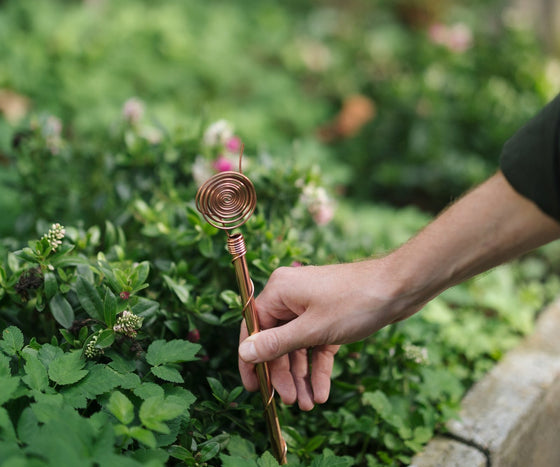
The copper electroculture stakes you place in your own garden today stand in exactly this long line: from Narkiewicz-Jodko's two hundred hectares, via the buried copper plates of the Timiryazev Academy, to the greenhouses of Soviet space stations. Want to give that tradition a place of its own? Check out the copper electroculture stakes, read how to place them in placing electroculture antennas, or dive further into the history via electroculture: a centuries-old gardening tradition rediscovered.