Placing electroculture antennas: where, how deep and how many
Which plants do you put a copper antenna beside, how deep does it go into the soil, and how many do you need? The practical side of electroculture.
Written and source-checked by the Kopero editors · Updated September 5, 2026

The question that comes after the purchase
There is plenty to read about electroculture: where the tradition comes from, what Abbé Nollet described in 1749 and what has been published since. That history is in electroculture. What is written about far less is the question you ask the moment the antennas land on the doormat: where exactly do I put them?
In short
- Push them upright into the soil, beside the plants you want to start with.
- Push them in by the rod, never by the spiral.
- Reckon on 8 to 20 centimetres deep, until they stand firm and will not blow over.
- Spread a few across a bed rather than putting one in the middle.
- They can stay outside all year; take them out before you dig or mow.
Which length for which spot
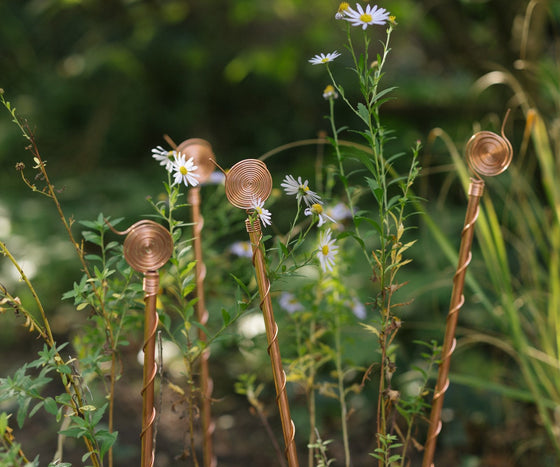
The 30 centimetre antenna is the size for pots, planters and balcony plants, indoors and out. The 60 centimetre one is meant for borders, the vegetable garden and taller plants, where it needs to reach above the crop.
Both are fully solid copper, the rod included. There is no wooden core, and they work in exactly the same way; the only difference is reach and height.
How deep, and how to hold it
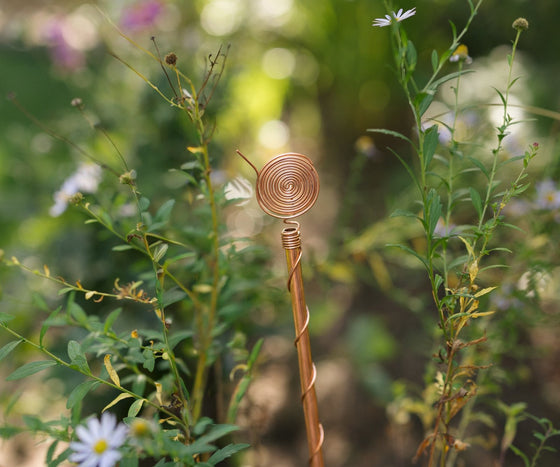
Push the antenna into the soil by the rod, not by the spiral. The spiral is bent by hand and loses its shape if you put force on it. Eight to twenty centimetres is enough, depending on the length and on how loose your soil is: it has to stand firm and not blow over at the first gust.
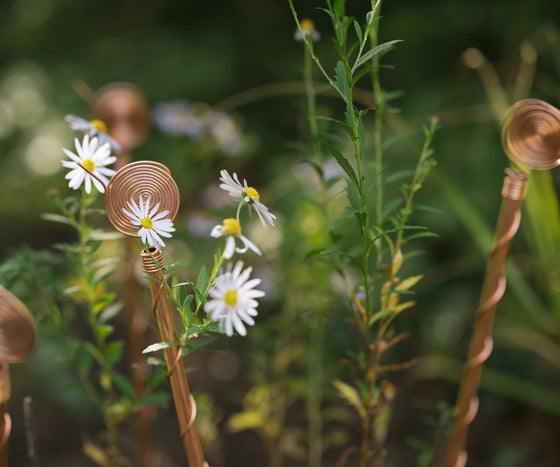
Put it beside the plant you want to treat, on the sunny side and out of the walking route. Keep the spiral clear above the plant and do not cover it with leaves, netting or fleece.
How many antennas do you need?
The set is four, and they are not meant to stand in one spot together. Spread them across the bed or across the pots you want to start with. If you want to compare, put them in one half of the bed and leave the other half as it is. More has been measured than you might think: the British Ministry of Agriculture reported yield increases of 30 to 50% between 1918 and 1936, and Nature Food published peas in 2022 that germinated 26.3% faster. What it does for your crop and your season is something you only see once you put those two halves side by side.
Outside all year
Copper stands up to the weather outdoors, so the antennas can stay put, winter included. They take on a green patina by themselves. That is normal, it belongs to untreated copper and it does not need polishing off; what discolouration does and does not mean is in why copper turns green or black.
Do take them out of the soil before you dig, hoe or mow. An antenna you catch with a spade is bent, and bending it straight again costs the copper more than you would think.
Put them in and leave them
You do not have to connect them to anything. They work on shape and on the copper itself: no electricity, no battery, no maintenance. You put them in the ground and let the rest of the season take its course.
Have a look at the copper electroculture antennas in 30 or 60 centimetres, or browse the full range.