Buying a copper bottle: what to look for
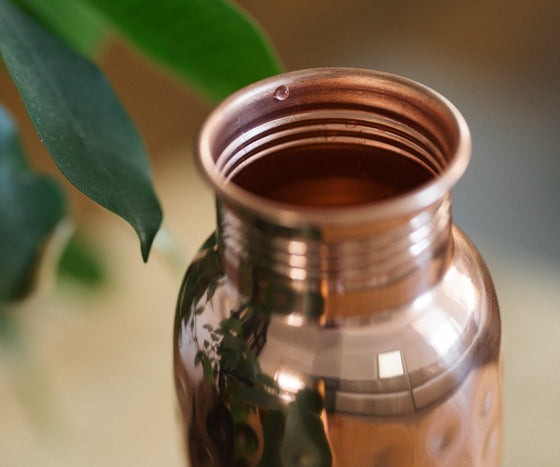
Most copper bottles look identical in a photo. The difference sits in the inside, the seam, the closure and the wall thickness.
Written and source-checked by the Kopero editors · Updated September 5, 2026

In a photo they all look the same
Search for a copper bottle and you get dozens of results that cannot be told apart in the product photo. Still, between the cheapest and the most expensive there is a difference you only notice once you have it in your hands, or worse, after three months. Here is what to look at, in the order in which it matters.
In short
- Ask for an independent measurement, not for a percentage on the sales page.
- Check whether the inside is bare copper or has a coating.
- Look at the seam and the base: that is where you see the handwork.
- Ask what the cap is made of and whether it opens comfortably.
- Weight tells you more about wall thickness than a figure in millilitres does.
- Watch the small things: a felt base, a lever on the cap and a carry bag are things you use every day.
1. Purity: claim or measurement?
Almost every seller puts a percentage on the page. What you want to know is whether anyone measured it and who. A claim without a report is a claim; a measurement by an independent lab can be checked.
Our bottle was independently measured at 99.21% purity and examined for nineteen heavy metals, none of which were found. Exactly what was measured and by whom is in what our copper products are made of.
2. Coating: does the copper touch your water?
This is the most important question and at the same time the least asked one. Many metal water bottles have a layer of plastic or epoxy on the inside against taste transfer. Then the outside is copper and the side touching your water is not, while that contact is the whole point: bare copper works against bacteria by nature and is a trace element your body works with every day. A coating puts a layer in between.
If it is not stated, ask. A seller who does not know the answer does not know what he is selling. More on that in microplastics and your water bottle.
3. Seam and base
A copper bottle is formed from sheet metal and therefore has a seam. In good work it is tight and even; in rushed work you see a wavy line or a thick solder edge. Look at the base too: it should be flat so the bottle does not wobble.
Turn the bottle over as well. Under our base there is a layer of felt, on both versions. It sets the bottle down softly, keeps it still on a smooth table and spares your table top. A small thing you hear every day, or rather do not hear.


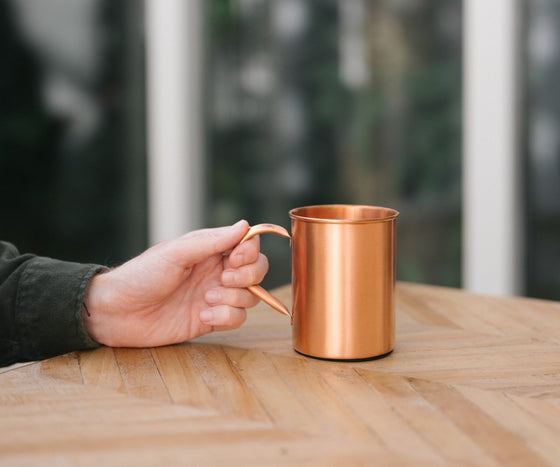
With a mug you look at the handle. It has to sit firmly and not give way when you lift it full. Under the mug sits the same felt.
4. The cap and the small parts
The bottle can be solid copper and the cap plastic with a rubber ring. That need not be a problem, but you want to know, certainly if the material is the point for you. Ask what the cap is made of and whether the seal can be replaced.
Look at how the cap opens as well. Our cap has a lever on it: you turn it open and shut in one movement, even with wet hands, and you lift the bottle out of your bag by it. That sits on both versions too.


5. Weight and wall thickness
Two bottles of 900 millilitres can differ considerably in weight, and that difference sits in the wall. Thin walled copper is lighter and cheaper to make, but dents sooner and feels like tin when you pick it up. If a seller does not mention the weight, that in itself is an answer.
6. Origin and handwork
Copper drinkware largely comes from India, where the craft is centuries old. That says nothing about quality on its own: work there ranges from beautiful to sloppy. What does say something is whether a seller can tell you anything about it. Our products are made by hand in India and the hammered version is different piece by piece, because the pattern is struck by hand.
7. What comes with it
A bottle is more than the bottle alone. With us a velvet carry bag comes with it, so it does not knock against your keys in your bag, plus a sturdy branded box and a card with a QR code to the manual for exactly your version. So when you compare, look at what is in the box as well: in daily use it matters more than you would think beforehand.

What a test report does and does not say
A lab report on purity and heavy metals says something about the material. It says nothing about the finish, the cap, the seam or how the bottle holds up after a year. The other way round, a nice photo says nothing about what is inside. You need both, and most sellers deliver only one.
And the price?
Solid, bare copper with an independent measurement costs more than copper plated steel or thin walled copper with a lacquer layer. What you get back is a bottle that lasts you decades and that you can polish up instead of replacing. On top of that, copper itself has become considerably more expensive in recent years: why that happened is in why copper got more expensive. What solid copper does for you beyond that, from the antibacterial effect to the trace element in your metabolism, is in benefits and drawbacks. Exactly where the price difference between two copper bottles sits is in why one copper bottle costs 30 euros and another 60.
How to tell real copper from copper plated metal is in how to recognise real copper. Still unsure about the size, have a look at which size copper bottle. Or go straight to the copper water bottle in the full collection.