Microplastics and your water bottle: what the material choice changes
Why microplastics in drinking water keep making the news, where they come from, and what that means for the bottle you drink from.

Why this subject is not going away
Microplastics in drinking water have been in the news regularly for several years. Studies of bottled water have repeatedly found particles in it, and every time the measurement method improves the count goes up, because smaller particles become visible that used to slip through. That makes it a subject you have to reckon with when buying a water bottle.
In short
- Microplastics reach drinking water through the source and through the packaging.
- A plastic bottle wears: scratches, heat and sunlight speed that up.
- A bottle of solid metal releases no plastic, because there is no plastic in it.
- Check the inside too: plenty of metal bottles do have a plastic coating.
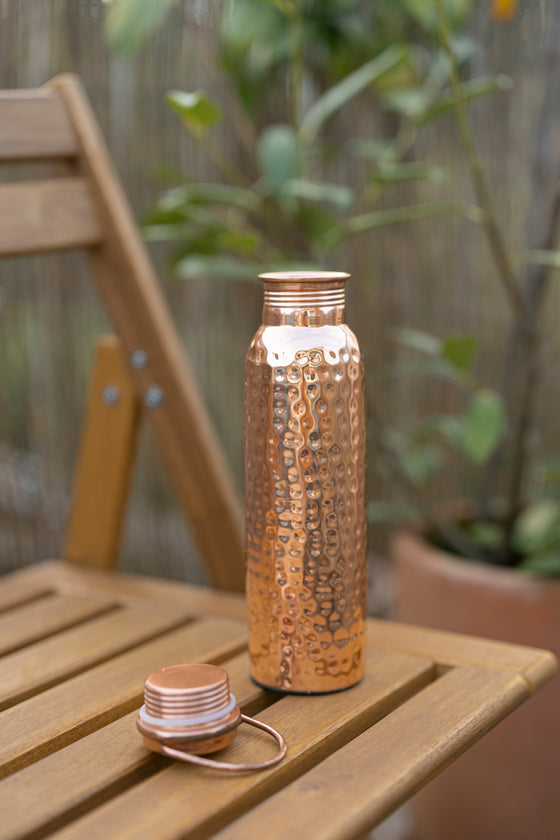
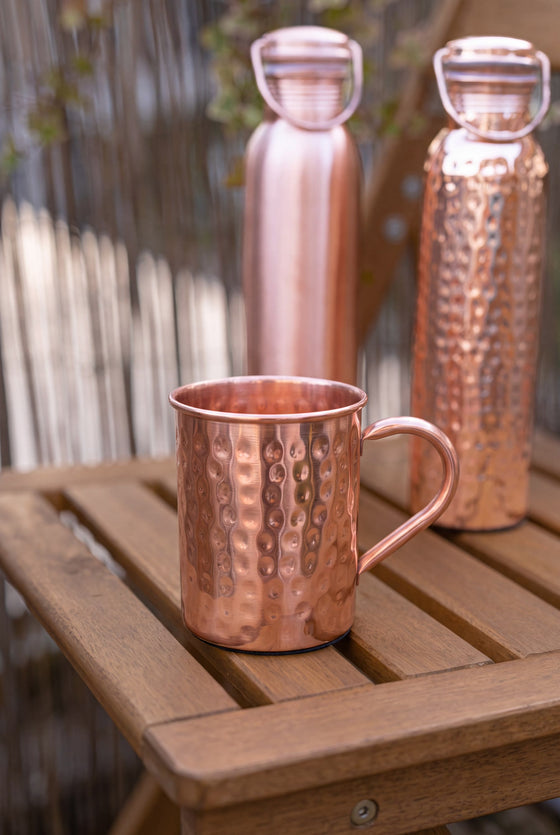
- Our bottle is solid copper with no coating and no inner lining.
Where it comes from
There are two routes. The first is the water itself: microplastics are by now in surface water, in soil and in the air, and some of that ends up in the water chain.
The second route is the packaging. A plastic bottle wears down through use: every scratch, every wash and every time it lies in a warm car or stands in the sun speeds that up. The bottle itself slowly becomes a source.
What the material choice does and does not solve
A bottle of solid metal cannot release microplastics, for the simple reason that there is no plastic in it. Whatever was in your tap water is still in it: a bottle is not a filter. But the second route, the bottle as a source, drops away.
There is a catch. Plenty of metal water bottles have a coating on the inside, often plastic or epoxy, to keep flavours from transferring. Then the outside is metal and the side touching your water is not. That is exactly the question to put to a seller. How to establish things like that about a bottle is in how to recognise real copper.
Why copper needs no coating
Ours has none. The copper you see on the outside is the same copper your water touches: solid, independently measured at 99.21% purity and tested against the European food-safety standards. In the test for nineteen heavy metals not one was detected. The full measurement is in what our copper products are made of.
Leaving the copper bare has a price: it tarnishes, and you have to polish it now and then. What that means in practice is set out honestly in benefits and drawbacks.
The comparison in short
Plastic is light and cheap and it wears. Stainless steel is strong and neutral in taste, but often has a coating on the inside. Copper is heavier, costs more, tarnishes, and is the only one of the three that in this tradition is also meant for letting water stand in it. The full comparison is in copper vs. plastic vs. stainless steel.
We make no health claims. What may officially be said in the EU about copper is in the eight official EU claims.
Have a look at the copper water bottle or browse the full range.