Copper bottle: the benefits and the drawbacks, honestly side by side
What a copper water bottle gives you and what it asks of you, both honestly: the material, the antibacterial argument, and the points to watch in daily use.
Written and source-checked by the Kopero editors · Updated September 5, 2026

The question behind the question
Read about copper water bottles for the first time and you mostly meet big promises. We stick to what can be measured: below is what a copper bottle actually gives you and what it asks of you.
In short
- Copper is the only common drinking material that does something on its own: in tests by the US Environmental Protection Agency, cleaned copper killed more than 99.9% of bacteria such as MRSA and E. coli within two hours.
- It is also a trace element your own body uses, from energy metabolism to the transport of iron in your blood. Stainless steel and plastic are inert.
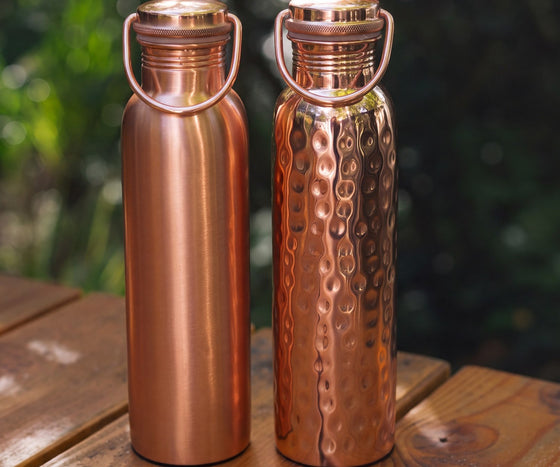
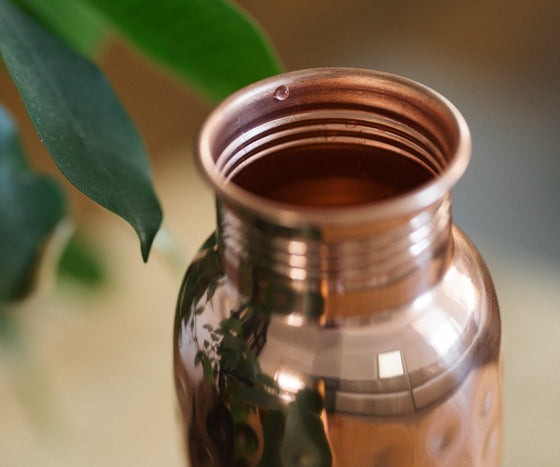
- The material is solid copper with no coating and no inner lining, which you polish back after years rather than replace.
- The tradition behind it is tamra jal: leave water standing in copper overnight and drink it in the morning.
- What it asks of you: hand washing, the occasional polish with lemon and salt (not too hard: salt is mildly abrasive and dissolves well in the lemon juice), and still water only.
What a copper bottle gives you
The first advantage is the material itself. Our bottle is solid copper, independently measured at 99.21% purity and tested against the European food-safety standards. No coating, no inner lining, and in the test for nineteen heavy metals not one was detected. What was measured, and by whom, is in what our copper products are made of.
The second is that copper does something neither stainless steel nor plastic does. In tests by the US Environmental Protection Agency, cleaned copper killed more than 99.9% of bacteria such as MRSA and E. coli within two hours, and since 2008 it has been registered there as an antimicrobial surface material: the first solid material ever to receive that registration. In the intensive care units of three American hospitals, healthcare-associated infections were 58% lower in rooms with copper surfaces. Stainless steel is inert and does nothing of its own accord. The full evidence is in can copper really kill bacteria.
The third is that copper is not a foreign material to your body. It is an essential trace element: it sits in cytochrome c oxidase, the enzyme your cells use for the last step of respiration, and in ceruloplasmin, which releases iron from your liver stores so your blood can carry it. Without copper that iron stays put, however good your iron levels are. How that works is in iron, copper and fatigue.
The fourth is that copper does not wear out the way plastic does. A plastic bottle that scratches and yellows gets thrown away; a copper bottle that goes dull gets polished and carries on. Copper can also be recycled endlessly without losing quality. The full comparison with plastic and stainless steel is in copper vs. plastic vs. stainless steel.
And the fifth is the habit the bottle comes from. Water that has stood in copper overnight and that you drink first thing in the morning: that is tamra jal, described in the foundational texts of Ayurveda. What those texts actually say is in tamra jal.
What it asks of you
Copper tarnishes, and that is exactly what you want to see. A bottle with a lacquer coating never tarnishes; the surface going duller after a few weeks is the visible proof that your water is touching the metal itself. Half a lemon and some salt (not too hard: salt is mildly abrasive and dissolves well in the lemon juice) polish it back in a few minutes. How often and how is in caring for a copper bottle. What discolouration does and does not mean is in why copper turns green or black.
So hand washing, no dishwasher: the detergent and the heat attack the surface. Rinsing with warm water is usually enough.
And still water goes in, nothing else. Lemon water, soft drinks, carbonation and very acidic fruit teas are acidic enough to dissolve copper faster. Water is exactly what copper drinkware is made for, and what the tradition has used it for these three thousand years.
Copper conducts heat. Fill it with hot water and the outside gets hot too. For cold water that is exactly what you want, because the bottle feels cool in your hand within a minute.
It weighs more than plastic and costs more than thin-walled stainless steel. That weight is the wall thickness that makes it last decades, and that price you pay once instead of every two years.
How much copper do you actually take in?
Copper is an essential mineral: your body needs it and normally gets it from food. Water that has stood in a copper vessel contains a small amount of dissolved copper, and that is exactly why the test against the European food-safety standards matters: those standards set what a material may release into drinking water. Our bottle was tested against them and passed.
The tradition already allows for that: one vessel, one night, drunk in the morning. Do it that way, with water rather than acidic drinks, and you stay comfortably within the usual range. What may officially be said in the EU about copper and your body is in the eight official EU claims.
One medical note
If you have Wilson's disease, or another condition where your body does not clear copper properly, talk to your doctor first. The same applies if you have been asked for any other reason to watch your copper intake. For everyone else, copper is simply one of the minerals your body works with every day.
The trade-off
What you buy is a bottle of one single material, with no coating and no inner lining, that lasts decades and that you polish back instead of replacing. With it comes a habit three thousand years old, and a metal that is the only one of the common drinking materials to be naturally antibacterial. What it asks of you is hand washing, half a lemon now and then, and the agreement that only water goes in. For most people who own one, that is not a price but the ritual itself.
Have a look at the copper water bottle, or compare it with the mug, tumbler and jug in the full range.