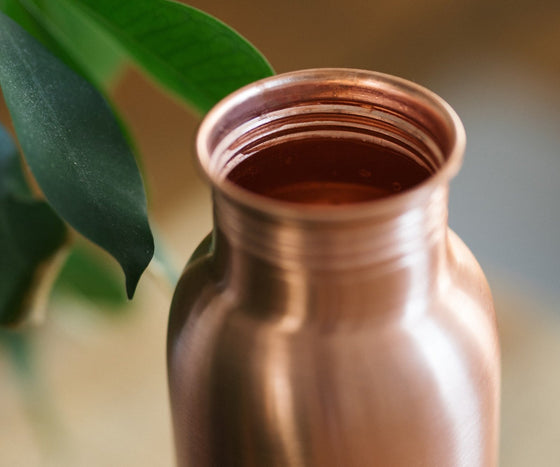
Can copper really kill bacteria? The evidence, from the EPA to Southampton
EPA registration, research from Southampton and a drinking water study from India: this is the evidence behind copper's antibacterial action.
Written and source-checked by the Kopero editors · Updated August 20, 2026

An old belief, tested again
People have used copper vessels and tools for drinking water and wound care for thousands of years, long before anyone knew what a bacterium was. The Edwin Smith Papyrus, an Egyptian medical document more than 3,500 years old, already describes a copper salt solution as part of wound treatment. The Greeks went even further: the Hippocratic Collection describes dry copper oxide powder applied to fresh wounds as a remedy against infection. Only in recent decades, however, has serious, controlled laboratory research been done into whether there's science behind it. The answer is surprisingly clear: yes, copper has demonstrable antibacterial properties.
In short
- The EPA officially registered copper alloys containing at least 60% copper as an antimicrobial surface material in 2008, the first-ever registration for a solid material
- In EPA tests, cleaned copper surfaces killed more than 99.9% of bacteria such as MRSA, E. coli and VRE within two hours
- Research by Professor Bill Keevil (Southampton) showed that norovirus was inactivated on copper within 5 to 10 minutes, and the flu virus within six hours
- In the New England Journal of Medicine, SARS-CoV-2 was no longer viable on copper after four hours, against two to three days on plastic and stainless steel
- In an ICU trial across three hospitals, 3.4% of patients in copper rooms picked up a healthcare-associated infection, against 8.1% in the standard rooms
- A meta-analysis covering 12,362 patients found 27% fewer healthcare-associated infections with copper surfaces and copper-containing linen
- Copper also demonstrably eliminates Clostridioides difficile spores faster than stainless steel
- A study from India showed that contaminated drinking water in copper vessels was completely free of bacteria within 16 hours
2008: the EPA puts it in writing
In March 2008, the US Environmental Protection Agency (EPA) officially registered copper alloys containing at least 60% copper as an antimicrobial surface material. That was the first time a solid material, not a liquid or spray, received such a registration. The tests preceding it showed that regularly cleaned, uncoated copper surfaces kill more than 99.9% of bacteria within two hours, including E. coli O157:H7, MRSA, Staphylococcus aureus, Pseudomonas aeruginosa and VRE.
The EPA is known for being cautious with this kind of registration, and only granted it after extensive, independent laboratory testing.
Southampton: copper against viruses
Professor Bill Keevil of the University of Southampton studied what copper does to viruses. His research showed that norovirus, notorious for stomach flu outbreaks, was inactivated on copper and copper-nickel alloys within five to ten minutes. The flu virus disappeared almost entirely within six hours. In 2020 the best-known example was added: a team from the US National Institutes of Health, the CDC, UCLA and Princeton measured how long SARS-CoV-2 stayed viable on different materials and published it in the New England Journal of Medicine. On copper nothing was detectable after four hours, while the virus lasted two to three days on plastic and stainless steel.
Keevil's work is one of the reasons copper surfaces increasingly show up in hospitals today, from door handles to bed rails.
From lab to hospital bed: the clinical evidence
The EPA tests and Keevil's work show that copper kills bacteria and viruses in the lab. But what happens when copper surfaces are actually installed in a hospital, where people are sick and surfaces are touched all day long?
A systematic review with meta-analysis in the Journal of Hospital Infection brought together seven clinical studies covering 12,362 patients between them. Copper surfaces and copper-containing bedding produced 27% fewer healthcare-associated infections (relative risk 0.73). The authors call that reason enough to set up larger, publicly funded trials.
The most striking result comes from a randomised controlled trial (RCT) in the intensive care units of three American hospitals, with 614 patients. They were randomly placed in rooms with either standard surfaces or copper alloy on the most frequently touched objects, such as bed rails, nightstands and screen bezels. In the copper rooms 3.4% of patients picked up a healthcare-associated infection, against 8.1% in the standard rooms, a difference that held up statistically (p = 0.013). On the copper components themselves, 83% less bacterial load was measured, and that with only around 7% of all surfaces replaced by copper.
Research has also been done against Clostridioides difficile, a stubborn, spore-forming bacterium notorious for hospital outbreaks of diarrhoea. Studies on copper surfaces against C. difficile spores show that copper fully eliminates the bacterium's vegetative cells within a few dozen minutes, and that copper-impregnated surfaces show a substantial reduction in spore counts after a few hours of exposure, something stainless steel isn't capable of.
India: copper in drinking water
A study by Sudha and colleagues, published in 2012 in the Journal of Health, Population and Nutrition, tested what happens to contaminated drinking water in copper vessels. Water containing around 500 colony-forming units of bacteria per millilitre was placed in copper pots. After sixteen hours at room temperature, no bacteria could be detected any more, even after enriching the sample. The copper that passed into the water stayed at 177 parts per billion, comfortably inside the 2,000 the WHO holds as its limit.
This phenomenon is called the oligodynamic effect, a name given to it in 1893 by the Swiss botanist Karl Wilhelm von Nägeli when he found that traces of certain metals are already enough to eliminate micro-organisms. A more recent 2025 study by Mishra and Tonni confirmed this again and found that copper vessels performed at least as well as traditional earthenware pots against bacteria such as E. coli, Salmonella and Staphylococcus aureus.
What this does and doesn't mean for your water bottle
This research was carried out under controlled laboratory or hospital conditions, using pure copper or copper alloys and experimentally contaminated water or surfaces. That's different from a copper bottle you fill with tap water every day. That's why we prefer to say "copper has demonstrable antibacterial properties" rather than "your bottle is guaranteed to kill all bacteria." The first statement, with this body of evidence behind it, is simply true. The EPA tests and the hospital studies themselves were also based on regularly cleaned surfaces: copper helps, it doesn't replace normal hygiene.
Why we chose copper
It's exactly this combination of centuries-old habit and modern laboratory and clinical evidence that convinced us to make drinkware from copper. Our Kopero water bottle gives you a piece of that old, well-substantiated trust every day: a material that has been used for drinking water since the Egyptians and the Ayurvedic tradition, and that modern science has now seriously confirmed.
Check out our Kopero premium copper water bottle, Kopero premium copper mug and Kopero premium copper cup, or browse the full range.