Coffee and tea from a copper mug: what to watch out for
Why a copper mug warms up within seconds, which coffee and tea belong in it, and what the handle is there for.
Written and source-checked by the Kopero editors · Updated September 5, 2026

The mug is the exception
With most copper drinkware the answer is short: water only. The mug is the exception. It has a handle, and that handle is there for a reason: it is meant for hot drinks. But not for all of them.
In short
- Black coffee and ordinary tea work perfectly well.
- Lemon tea, very acidic fruit teas and soft drinks go into a different cup.
- Copper conducts heat better than almost any other metal: the wall warms straight through, and that is what the handle is for.
- Pick it up by the handle and set it on a coaster.
- There is felt under the base, which protects a wooden table.
What can go in
Black coffee and ordinary tea are no problem. Water is fine too, and the tamra jal ritual works with a mug just as well as with a bottle: fill it in the evening, let the water stand overnight and drink it in the morning. Where that habit comes from is in tamra jal.
What belongs in a different cup
Anything acidic. Lemon tea, very acidic fruit teas, soft drinks and carbonation are acidic enough to dissolve bare copper faster, and that speeds up the release. A brief contact with something acidic is no problem, as when polishing with lemon, but leaving it standing for hours is.
Milk in coffee is not itself an objection, but do not leave the mug unwashed afterwards: milk residue dries hard in a warm mug and is harder to remove without an abrasive, and abrasives are what you want to avoid here.
Why the mug warms straight through
Of all metals only silver conducts heat better than copper, and earthenware is nowhere near. That is exactly what makes the mug different: cold water feels cold in your hand within seconds, and a hot drink warms the wall just as fast. Where that conductivity comes from is in why copper conducts.
Hence the handle. Pick the mug up by it and set it on a coaster rather than straight onto the table. There is felt under the base, which protects a wooden top and takes the noise out of setting it down.
Cleaning the mug
Hand wash with warm water and a soft cloth, and dry immediately. Not in the dishwasher: the detergent and the heat are too aggressive for the surface and leave dull, uneven marks. Keep the felt under the base as dry as you can.
If the mug tarnishes over time, that is normal and precisely the mark of bare copper. Lemon and salt (not too hard: salt is mildly abrasive and dissolves well in the lemon juice) bring the shine back; the full routine is in cleaning and polishing, and what discolouration means is in why copper turns green or black.
Smooth or hammered
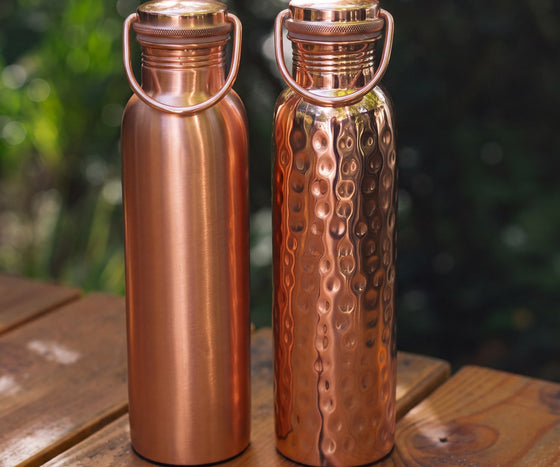
For the capacity it makes no difference; 400 millilitres is 400 millilitres. The smooth surface gives one continuous reflection; the hammered version breaks the light up across small facets and shows fingerprints less. The difference is covered more fully in smooth or hammered copper.
Have a look at the copper mug or browse the full range.