Why copper got more expensive, and what that does to your bottle
Copper passed 12,000 dollars a tonne for the first time in December 2025. Where that demand comes from, why supply does not follow, and why this plays out differently for a copper object than you would expect.
Written and source-checked by the Kopero editors · Updated September 8, 2026

The metal got more expensive, and that is no accident
In December 2025 copper passed 12,000 dollars a tonne for the first time, and in January 2026 it briefly touched 14,500. For a metal that has been mined for thousands of years that is remarkable, and it has little to do with speculation.
Below is where that demand comes from, why supply does not follow, and why this plays out differently for a copper object than for most things that get more expensive.
In short
- Electrification is the engine: power grids, electric cars, solar and wind farms and data centres all run on copper.
- The International Energy Agency expects demand to grow by up to 48% by 2040.
- The average ore grade of copper mines has fallen 40% since 1991: more and more rock has to be moved for the same tonne of copper.
- A new mine takes years, so supply cannot follow a spike in demand quickly.
- Copper is infinitely reusable without loss of quality, and that makes a copper object something other than a consumable.
Where the demand comes from
Everything that carries electricity asks for copper. Of all metals only silver conducts better, and silver is unaffordable for cabling. That makes copper the standard material for power grids, motors, transformers and wiring, and why that is so in physical terms is in why copper conducts.
In recent years new buyers have arrived, all knocking at once: grid expansion, electric cars, solar and wind farms, and lately data centres. The International Energy Agency allows for global copper demand growing by almost half by 2040.
Why supply does not follow
This is the real bottleneck. The average ore grade of copper mines has fallen 40% since 1991. That means moving almost twice as much rock for the same tonne of copper, and that costs energy, water and money.
On top of that, a new mine does not run next year. Between finding a deposit and the first delivery sit years of permits, financing and construction. When demand then accelerates, supply simply cannot keep up. Individual setbacks make it sharper: a landslide at Grasberg in Indonesia, one of the largest copper mines in the world, halted production well into 2026.
What that means for a copper object
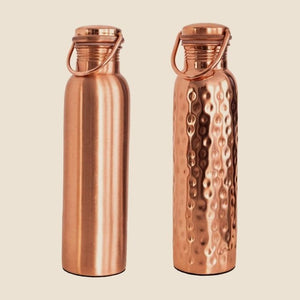
With a bottle, a jug or a bracelet, the metal is a real cost and not a detail. A 900 ml copper water bottle is 300 grams of solid copper, and that is exactly the material the world market is competing for. If the raw material gets more expensive, that carries through.
It also explains straight away why a strikingly cheap copper bottle raises questions. If the raw material is expensive and the price stays low, something has been left out somewhere: thinner metal, a lacquer layer that makes it cheaper, or no measurement at all of what is in it. Where the price difference actually sits is in why one copper bottle costs 30 euros and another 60.
And now the pleasant part
With almost everything that gets more expensive, that value is gone the moment you use it. Not with copper. The metal is infinitely reusable without loss of quality: a large share of all the copper ever mined is still in circulation. The jug you buy today is still copper in fifty years.
And because there is no coating over it, you never have to replace it either. Discolouration polishes back, scratches come with use and the shape stays. What that adds up to over the long run is shown fairly convincingly by four copper objects that survived the centuries. A metal growing scarcer, in a form you keep using, is about the opposite of a throwaway item.
How copper compares with plastic and stainless steel, on this point too, is in the material comparison.
What we do about it
We buy the same metal on the same market as everyone else. What we do not do is absorb the price by going thinner or putting a lacquer layer on it, because then you are selling something other than what people came for. What is in our copper has been measured and can be read in what our copper products are made of.
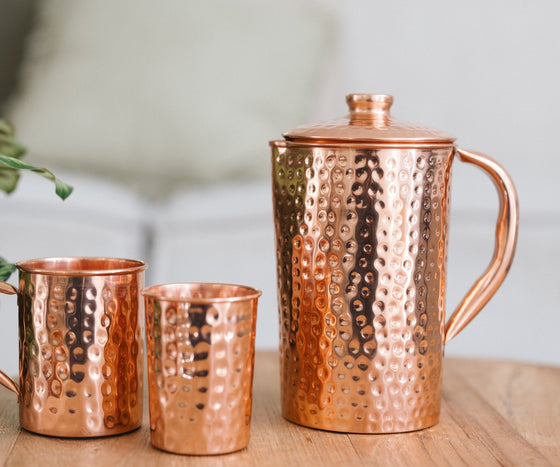
Have a look at the copper water bottle, the jug and the bracelet, or browse the full Kopero collection.