Copper in Vastu Shastra and Feng Shui: where tradition places it
Two traditions, both with a compass in hand. What Feng Shui does with copper as the metal element, what Vastu does with direction and water, and what of that has been measured.
Written and source-checked by the Kopero editors · Updated September 8, 2026

Two traditions with a compass in hand
Vastu Shastra and Feng Shui come from different worlds, India and China, and share one starting point: where something stands matters. Both divide a space into directions, and both tie materials to those directions. Copper appears in both, and in a surprisingly concrete way.
Here is what each tradition does with copper, how you apply that in practice, and what has been measured about the metal and the shape.
In short
- Feng Shui works with five elements. Copper falls under metal, together with gold, silver and brass.
- In the bagua, metal belongs to the west and the north west.
- Vastu links the west with stability, and knows copper mainly as the material for drinking water.
- Round and curved shapes belong to metal in Feng Shui, so a closed ring and a pyramid of copper wire fit right in.
- The teaching of directions is centuries old tradition, and alongside it sits measured work on the metal and on shape.
Feng Shui: copper falls under metal
Feng Shui works with five elements: wood, fire, earth, metal and water. Each element has its own materials, colours and shapes, and each element belongs to a part of the floor plan. Copper falls under metal together with gold, brass and silver.
In the bagua, the grid you lay over a floor plan, metal belongs to the west and the north west. In that teaching the west is linked with creativity and with children, the north west with helpful people, travel and mentors. So anyone working this way puts metal there: a copper object on a shelf on the west side of the room, or in the north west corner of the home.
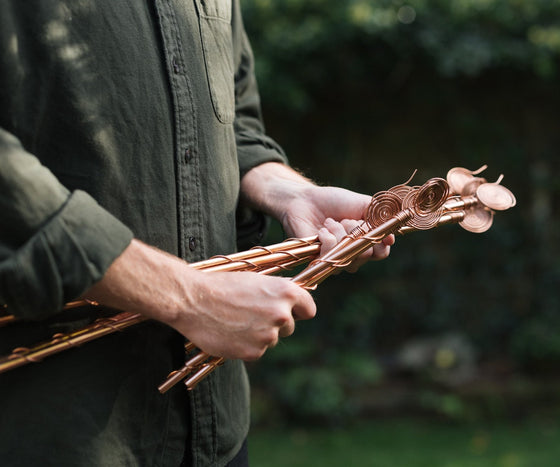
Shape counts too. In Feng Shui metal belongs to round and curved forms, and that is exactly what a closed copper ring is, or a pyramid of twisted copper wire. Where the wider idea that shape itself does something comes from is in Shape Power.
Vastu Shastra: direction and water
Vastu Shastra is the old Indian teaching on building and furnishing, and like Feng Shui it works with directions. In it the west is linked with stability and with financial matters, which puts it close to what Feng Shui places on that side. Two traditions that never met and still land on the same compass point: that is striking at the very least.
Where Vastu gets more practical than Feng Shui is with water. In the Indian household tradition copper is the material drinking water stands in, and that is the same habit Ayurveda calls tamra jal: fill it in the evening, let it stand overnight, drink it first thing in the morning. There the two traditions run into each other. The background is in tamra jal, the Ayurvedic tradition.
And with the pyramid, direction returns in a way you can do yourself: line it up with a compass on the north south axis. That is not decoration but the instruction, and it is set out step by step in how to use a copper pyramid.
What you actually do with it
The pyramid goes in a fixed spot with one side on the north south axis, and stays there. Whatever you put underneath sits at about a third of the height.
The tensor ring hangs around the tap or lies loose beside a jug or a glass. As a closed round form in metal, that is a double hit in Feng Shui terms. How to use it is in using a tensor ring.
The jug or the bottle belongs to the water part of the story: fill, let stand, drink. That is the side that is most concrete in Vastu and Ayurveda.
The bracelet falls outside the floor plan, because it travels with you. In the tradition that links copper to Venus, that is precisely the point; that story is in copper as the metal of Venus.
Tradition and measurement side by side
The teaching of directions in Vastu and Feng Shui is thousands of years old and is still used every day to arrange homes. We pass it on as it is, and we set beside it what has genuinely been measured about copper.
That measured part is about the metal and about shape. Copper surfaces kill bacteria on contact, and the American EPA registered copper alloys on that basis; that evidence is in can copper really kill bacteria. And at Manipal University, peer reviewed animal studies found lower stress hormones under a pyramid model than in a cube of the same dimensions, which says something about the shape itself. The whole line from Bovis through Drbal to Golod is in the history of pyramid energy.
What you experience yourself comes on top of that, and the tradition stands on its own feet. What we add is the material: independently measured at 99.21% copper and held against the European rules for food contact. Exactly what is in it is in what our copper products are made of.
Where to begin
Pick one spot and one object rather than mapping out the whole house. A pyramid on a cabinet in the west of the living room, or a tensor ring around the kitchen tap, is enough to find out whether you like it.
Have a look at the twisted pyramid, the smooth pyramid and the tensor ring, or browse the full Kopero collection.