Shape Power: how form focuses energy, according to this tradition
What is Shape Power? Discover how form directs energy and why the Kopero measurements of 14.56 and 23.56 centimetres form a precise golden-ratio sequence.
Written and source-checked by the Kopero editors · Updated August 20, 2026

Lay a piece of copper wire straight on a table and it's a conductor. Bend that same wire into a circle, a spiral or a pyramid and something new appears: an interior space, a direction and a centre point. Shape Power starts with the question of whether such a form can itself be active.
Within this tradition, geometry acts as a lens or waveguide for subtle energy. The circle gathers, the spiral lets it flow, and the pyramid directs it. The material still matters, but the arrangement gives the material its task.
In short
- Shape Power is the view that geometric forms can gather, order, amplify or direct energy.
- Dan Davidson described circles, spirals, triangles, pyramids and crystal shapes as energetic waveguides.
- According to this model, the circle concentrates energy at the centre; the spiral gives it movement and direction.
- In 1949, Karel Drbal filed a patent for a pyramid-shaped holder for razor blades.
- Patrick Flanagan connected pyramid shape, Kirlian photography, magnetic orientation and biocosmic energy.
- Davidson wrote that copper transmits the pyramid shape's effect more strongly than plastic or cardboard.
- Rubik and Jabs reported 19.0% more biomass in beans under a pyramid, and 31.4% with pyramid plus intention.
- Peer-reviewed animal studies (Manipal) found lower stress markers under a pyramid model than in a cube of equal size, specifically with north-south alignment.
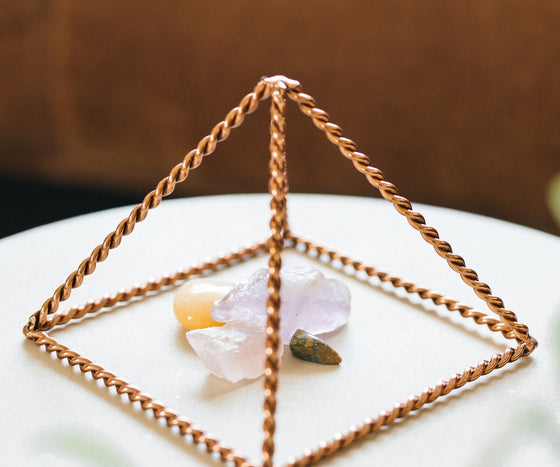
- The Kopero pyramid comes in 14.56 and 23.56 centimetres, each with smooth or twisted copper edges.
What Shape Power actually means
The word "shape" refers to form. Shape Power is about the effect that arises from bringing lines, angles, curves and proportions together in a particular way. According to researchers within this tradition, a shape influences how subtle or etheric energy moves through a space.
Dan A. Davidson worked out this idea in his book Shape Power. He describes two-dimensional drawings and three-dimensional objects as waveguides: forms that don't need to produce energy, but gather it and give it direction. An antenna doesn't create radio waves itself either. The geometry determines which movement it picks up and passes on.
Shape Power uses a broader energy model than ordinary electromagnetics. Davidson speaks of etheric energy, while other authors use words like biofield, life force, orgone, torsion or scalar energy. The words differ, but the recurring idea is the same: empty space isn't truly empty, and form influences what moves through it.
The circle: gathering around a still centre
A circle has no beginning, no end, and no sharp corner through which movement can escape. In Davidson's model, all the tangent lines of the circle work towards the centre. This creates a point of concentration in the middle.
You recognise that idea in a tensor ring. The copper forms a closed loop, while the open centre is exactly where, according to the Light-Life tradition, the tensor plane arises. So the power doesn't lie only in the metal itself, but in the relationship between the copper boundary and the space it encloses.
The circle has also been used in magic and ritual for centuries to mark out a space. Within Shape Power, that symbolic act takes on an energetic model: the boundary orders the field, and the centre becomes a place of gathering.
The spiral: energy gains movement
The spiral adds direction to the circle. It can pull inward or open outward, depending on the direction of the twist and how it's used. Davidson saw the spiral as a natural route for etheric movement and pointed to the many vortex patterns found in water, plants, shells and weather systems.
In his book, he describes an early 1970s product: a spiral etched in copper on a circuit board, meant to energetically treat water, coffee and food. For Davidson, what was especially interesting was that multiple linked spirals could further amplify the movement.
You find the same shape in orgonite, electroculture, copper coils and twisted wire. Sometimes the spiral is visible. Sometimes it's hidden in the way two copper wires are twisted around each other.
The triangle and pyramid: directing towards a point
A triangle brings three lines together at three points. A pyramid turns that into a three-dimensional form: a broad base with lines running up to a single apex. Within Shape Power, that apex is seen as a director of direction. Energy is said to move upward along the sides and form a spiralling flow above the apex.
Within the pyramid itself, this tradition places an important point at around a third of the height. That's the level often linked to the King's Chamber in the Great Pyramid. Water, seeds, herbs, crystals and other objects are therefore placed at or around that height.
Orientation is part of the shape. Drbal, Flanagan, Davidson and later Rubik and Jabs aligned sides of their pyramids to magnetic north. According to their model, the geometry then works together with the earth's field.
That this specific alignment matters later received unexpected support from the laboratory. Researchers at India's Manipal University found in peer-reviewed animal studies that rats under a pyramid model had lower stress hormones and less oxidative damage than animals in a cube of the same dimensions, and a follow-up study from 2007 linked that effect to orientation on the north-south axis. The shape did the work, and the shape only worked well when it was positioned the way the tradition has always set it up.
Karel Drbal and the razor blade in the pyramid
The modern pyramid power tradition got a concrete document in 1949, when Czech radio engineer Karel Drbal filed a patent application for a pyramid-shaped holder. A used razor blade was placed horizontally in the pyramid, with its length running north-south. Drbal claimed the edge dried faster and its crystal structure recovered better as a result.
The patent was published years later as number 91,304. Drbal turned a large ancient structure into a small everyday object for the bathroom sink. In doing so, an important principle of Shape Power also became visible: the shape was said to be scalable. You don't need to sit inside a stone pyramid to work with the same geometry.
Patrick Flanagan and biocosmic energy
In 1972, Patrick Flanagan published The Pyramid and Its Relationship to Biocosmic Energy. His original set contained three small pyramids and a compass. Flanagan worked with Kirlian photography and described energy that was not only gathered inside the pyramid, but also radiated from its points and apex.
He investigated the relationship with magnetic fields and claimed the effect diminished when the pyramid was shielded from the earth's magnetic field. For users, the compass thereby became just as important as the pyramid itself. Placement was not a decorative choice, but part of the setup.
Dan Davidson: copper as an amplifier of the shape
Davidson broadened the subject beyond pyramids. He examined lines, intersections, circles, spirals, crystals and sacred geometry as variants of the same principle. According to him, material played a role in how well a shape could gather and transmit its field.
He wrote strikingly directly about pyramids. A copper pyramid aligned to the earth's magnetic field worked, according to his observations, much more strongly than a version made of plastic or cardboard. Where the shape determined the direction, the copper passed on the energetic movement more readily.
That makes copper more than a nice finish within Shape Power. It's the conductive skeleton of the geometry. Open edges are said to be enough to define the shape; solid side panels aren't necessary within this tradition.
Rubik and Jabs: what happens when intention joins in?
Beverly Rubik and Harry Jabs added another variable: consciousness. In a controlled pilot, they divided 24 bean plants into four groups of six. There was a control group, a group under a wooden pyramid, a group given directed intention, and a group with both pyramid and intention.
After a month, the above-ground plant mass was dried and weighed. The intention group had 22.7% more dry biomass than the control. The pyramid group came in 19.0% higher. The combination reached 31.4% more biomass, with the difference between the combined group and the individual groups being statistically significant.
In their paper Interactions of Pyramidal Structures with Energy and Consciousness, they therefore describe the pyramid as possibly operator-dependent. The shape isn't separate from the person working with it. According to their trial, intention can be part of the setup.
Shape Power in Kopero's forms
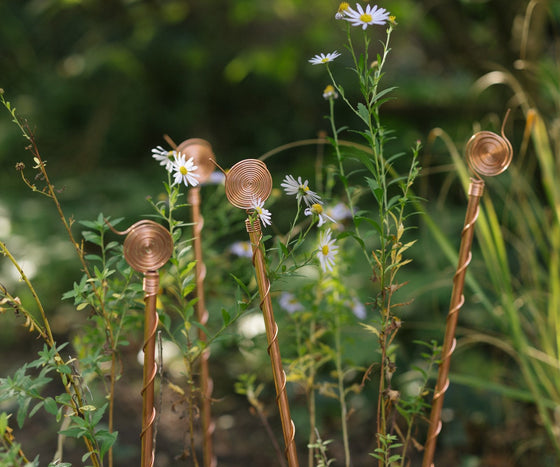
Once you start paying attention to shape, you see a clear family. The 4-centimetre Kopero tensor ring uses the closed circle and a compact open centre. The copper pyramid uses triangular faces, a square base and a single apex. The Kopero electroculture antennas use the vertical line and the spiral to connect earth and atmosphere. That set consists of four fully copper antennas in 30 or 60 centimetres, for pots and smaller plants or for a larger border.
The objects look different, but within Shape Power they do the same kind of work: they give a boundary, direction or rotational movement to a field. Copper makes that geometry visible and conductive.
Why 14.56 and 23.56 centimetres aren't random measurements
Kopero's two measurements reveal a strikingly precise golden-ratio structure. Divide 23.56 by 14.56 and the result is 1.61813. That's within six thousandths of a percent of phi, the golden ratio of 1.618034. It becomes even clearer when you work backward: 14.56 centimetres is, rounded, 9 × phi, and 23.56 centimetres is, rounded, 9 × phi². The larger measurement is therefore almost exactly phi times the smaller one.
That's where the special property of the golden ratio lies. With phi, the smaller part relates to the larger part the way the larger part relates to the whole. The same relationship recurs at the next scale. Within sacred geometry, that self-similar structure stands for harmony between part and whole, growth without losing the original proportion, and a shape that keeps the same order across different scales.
The difference between the two measurements is also meaningful: 23.56 minus 14.56 is exactly 9 centimetres. That fits the identity phi² = phi + 1. The sequence can therefore be read as 9, 9phi and 9phi². Whether the maker also deliberately chose the number 9 for numerological reasons isn't documented. The golden-ratio relationship itself is mathematically almost exact, though.
The older trail behind 23.56 centimetres
The largest measurement also has a striking predecessor in European dowsing (radiesthesia) literature. Michel Moine's Guide de la radiesthésie from 1973 describes a construction method for a pyramid model. Adrien Gesta later adopted that method in Radiestesia médica: a base of 23.56 centimetres, a height of 15 centimetres, and sloping edges of 22.41 centimetres. The model was placed north-south and the working point sat at around a third of the height.
That 23.56 centimetres comes from a classic Cheops approximation in which base divided by height is roughly pi/2: 15 × pi/2 is 23.56. Remarkably, the same number also lands almost exactly on 9phi². In a single measurement, two well-known threads from sacred geometry thus come close together: pi, which links circle and circumference, and phi, which expresses self-similar proportion.
The Kopero pyramid isn't the same model as Moine's. With Kopero, the edges are equal in length and the side faces form equilateral triangles of 60°. The match with the 23.56 measurement is therefore a historical and mathematical resonance, not proof that the product is an exact 1:1000 copy of Cheops.
The 60° shape as half an octahedron
The equal edges add another layer of their own. Four equilateral triangles over a square base form exactly half of a regular octahedron. Mirror the Kopero pyramid below its base, and you get a Platonic solid with eight equal triangular faces. The regular octahedron is therefore a shape of maximum symmetry and balance. The 60° mentioned refers technically to the angles within each equilateral side face; the slope angle of such a face relative to the base is about 54.74°.
In the Timaeus, Plato linked the octahedron to the element of air. Within contemporary energy work, that line is often extended to breath, clarity, movement, communication and the creation of space. The broad square base grounds, the four equal triangles bring balance, and the apex gives direction. In this way, this version unites earth at the base with the rising quality of air.
Four Kopero pyramids: two sizes and two copper finishes
Kopero offers the pyramid in two sizes and two finishes. Both the smooth pyramid and the twisted copper pyramid are available with edges of 14.56 centimetres and 23.56 centimetres. That gives four variants, all following the same 60° geometry and the same phi sequence.
In the smooth version, the copper edges run calmly and unbroken up to the apex, giving the shape a clear, minimalist look. In the twisted version, each edge consists of visibly twisted copper. That gives the pyramid shape a second geometric movement: the main lines direct towards the top, while the copper itself spirals along those lines.
The small pyramid at 14.56 centimetres fits easily on a desk, altar or nightstand. It's practical for a single piece of jewellery, a crystal, a written intention or a small dish. The large pyramid at 23.56 centimetres gives more interior space for a glass of water, several stones, herbs, fruit, or a broader intention setup. Energetically, small and large belong to the same golden-ratio sequence. Practically, you're mainly choosing how much space you want to create around the object, and whether the calm line of smooth copper or the extra spiralling movement of twisted copper appeals to you more.
How to place a copper pyramid
Set the pyramid on a stable surface and use a compass to align one side north-south. Place a glass of water, a crystal, a piece of jewellery or a written intention at around a third of the height. With a small open pyramid, a simple little riser can achieve that.
Work with one clear intention and give the shape time. Within this tradition, people often place water or small objects in the pyramid for several hours up to overnight. Seeds are sometimes left there for one to five days before planting. Write down what you do and what you experience, precisely because placement, time, orientation and attention are all part of the Shape Power model.
Further reading
- Dan A. Davidson, Shape Power
- Patrick Flanagan on pyramids and biocosmic energy
- Rubik and Jabs on pyramid, plant growth and intention
- Wolfram MathWorld on the golden ratio
- Adrien Gesta on the 23.56-centimetre radiesthesia model
- Pyramid energy: the history from Bovis to Golod
Want to work with conductive geometry yourself? Check out Kopero's copper pyramid in smooth or twisted versions, combine it with the tensor ring, or discover the full collection.