

A beautiful pyramid for my altar :)

Mir
Verified purchase
SHOP WITH CONFIDENCE 30 days to decide, money back if in doubt
FAST DELIVERY Order before 11:30 pm, usually delivered in 4-5 days


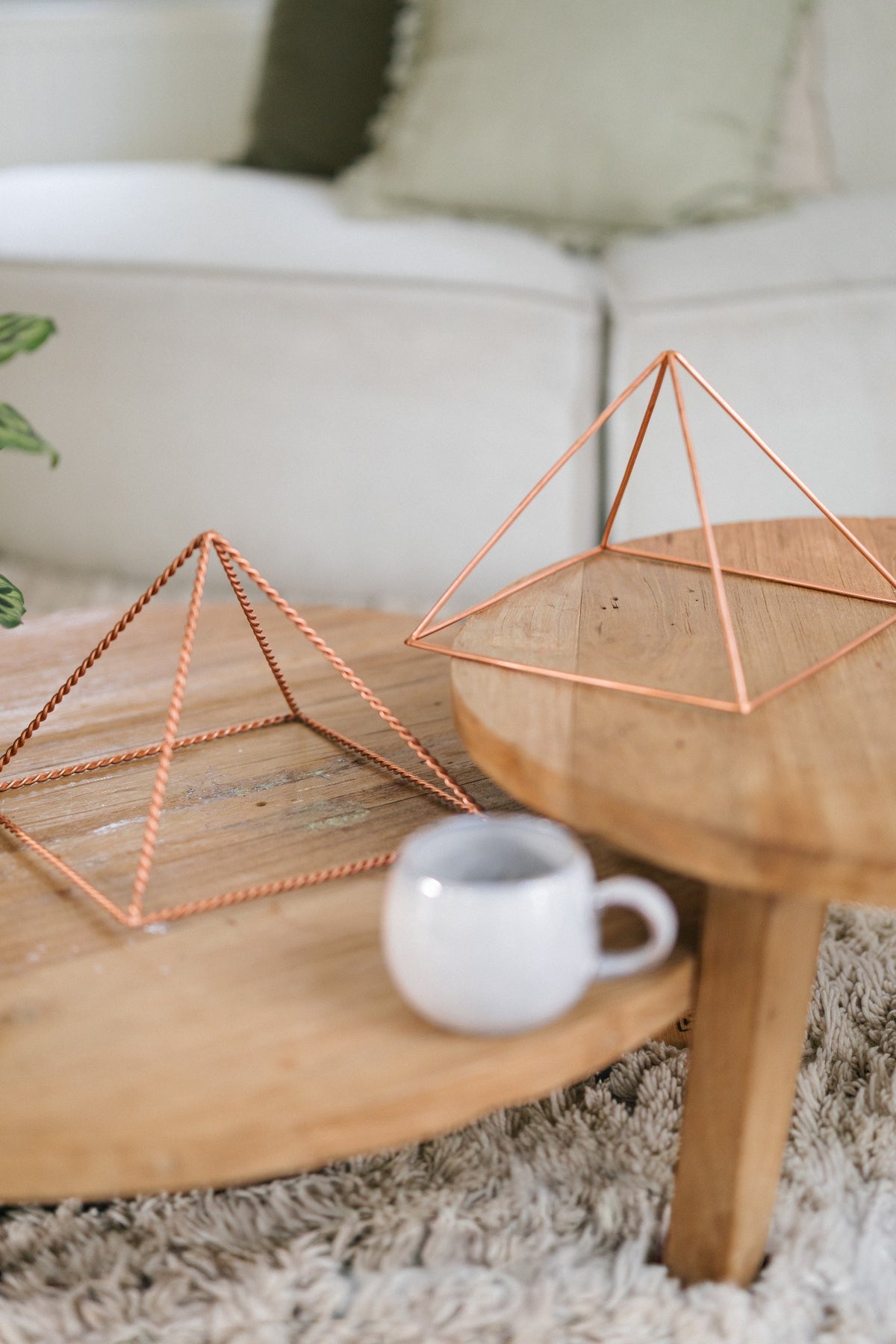
14.56 and 23.56 cm behave almost exactly like Phi: the small one fits on a desk, the large one on a table or windowsill.
Four equal edges meet at a point; mirror the shape below the base and you get a regular octahedron.
Smooth emphasises the pure line of the pyramid; twisted adds a visible spiral to every edge.
Peer-reviewed animal studies from Manipal University measured lower stress levels under a pyramid model than in an equally sized cube. A traditional object for personal use; experiences are individual.
Solid copper changes colour a little on its own over time. That's completely normal, and even a sign of pure copper. If you prefer the shine, simply polish the pyramid with lemon and salt (not too hard: salt is mildly abrasive and dissolves well in the lemon juice). Exactly how is in the care guide.

The material is analysed by RTC Laboratory in Moradabad, a NABL-accredited lab, tested to ASTM-1621 and IS-228. In the sample that was analysed the measurement came out at 99.21% copper and 0.75% zinc; the remaining 0.04% falls within the measuring range of the analysis. Food safety is covered by a second report, from URS Products and Testing: tested against EC 1935/2004 and REACH, using the heavy metal limits from EU 10/2011 as the benchmark.


An open pyramid of twisted copper wire: four equal triangles meeting at a single point, with 60 degree angles. There is nothing inside it and nothing around it, so you put something underneath and leave it there. How to use it is set out step by step in the knowledge base.
You choose between 14.56 and 23.56 centimetres, and that is no arbitrary difference: the two sizes stand in almost exactly the golden ratio. The small one fits a desk, an altar or a bedside table and is meant for a single piece of jewellery, a crystal or a written intention. The large one makes room for a glass of water, several stones, herbs or fruit.
In the twisted version the copper runs up each edge as a visible spiral. The pyramid draws the large line to the apex, and the twist lays a second, finer movement over it. If you would rather have calm, unbroken edges, there is the smooth pyramid.
Where the idea that shape does something comes from, and what of it was visible in the lab, is in Shape Power and in the history of pyramid energy.
Align one side with a compass to the north-south axis and then leave it be. In the Manipal studies the shape did its work precisely at that alignment; if you move it, align it again.
Pick the pyramid up by the base, not by the apex. The edges are copper and therefore pliable, and at the point all the weight rests in one place.
The copper discolours over the years, and that polishes back with lemon and salt (not too hard: salt is mildly abrasive and dissolves well in the lemon juice). Do it gently, following the direction of the twist. Why is my copper turning green or black explains what you do and do not need to do.
What we can hand you is the source. The tradition runs from Bovis through Drbal to Golod, and at Manipal University peer-reviewed animal studies found lower stress hormones under a pyramid model than in a cube of the same dimensions: the shape did the work, not the shelter. What you experience yourself comes on top of that.
From unboxing to a fixed spot. The pyramid needs no power, batteries or upkeep: align it and leave it standing.

Rub the ribs with lemon and salt (not too hard: salt is mildly abrasive and dissolves well in the lemon juice), rinse and dry right away. Hold the pyramid by the base, not the top.

Place the pyramid on a desk, altar or nightstand, on a flat surface where it can stand without easily tipping over.

Use a compass to turn one side onto the north-south axis. In the Manipal studies the pyramid worked with this alignment.

Put a piece of jewellery, a crystal, a written intention or a small bowl in the open space, ideally around a third of the height. Within this tradition, that point is considered the strongest.

Small objects overnight, seeds one to five days. As a living-space object it can simply stay.

Dust it with a dry, soft cloth. For more shine: lemon and salt (not too hard: salt is mildly abrasive and dissolves well in the lemon juice).
The packaging also carries a QR code that takes you straight to this guide.
Discover the two sizes, the classic 60° shape and the choice of material behind this copper pyramid energiser.

Choose the compact size for an altar, desk or a small object; the large size gives a setup more physical presence.
Four equal sides meet at a point, following the classic pyramid proportions.
The twisted wires give each edge a dynamic, handcrafted character.
In the ICP-MS analysis by URS Products and Testing, all nineteen heavy metals tested for were reported as 'Not Detected'.
You unpack a luxury black branded box. So you can give it away straight from the box, without wrapping anything around it.
A Kopero card is inside the box. The QR code on it takes you to the digital manual.
Four equal sides, all angles 60 degrees
14.56 or 23.56 cm, the golden ratio
Smooth or twisted
None of the 19 heavy metals tested for was detected
Polish it back, and melting copper down costs it nothing

Against a bare, dark background, nothing is left but the pyramid itself. That's exactly what Shape Power is about: pure geometry, with no distraction around it.

A crystal, a piece of jewellery, or a small intention: place it in the open space under the pyramid, ideally at around a third of its height. Within the Shape Power tradition, the shape is said to energetically charge that object, comparable to the King's Chamber in the pyramid of Giza. The twisted copper adds its own dynamic line to that.
Unpack it at your own pace, feel the weight and see whether the size suits you. If it is not for you, send it back within thirty days and get your money back. If you use it for longer than you need to judge it, we may deduct for loss of value. You arrange the return yourself with whichever carrier suits you best, or you ask us for a return label. The cost of sending it back is yours.
Read the return policyTranslated from Dutch
A beautiful pyramid for my altar :)
A lovely pyramid to harmonise the room

Cute pyramid :)

Beautifully made

Both sizes follow the same geometry: four equal edges and 60-degree angles on the side faces. The small pyramid fits nicely on a desk, altar or nightstand and is meant for a piece of jewellery, a crystal, a written intention or a small bowl underneath. The large pyramid needs a table or windowsill and has room for, say, a full glass of water, several stones, herbs or fruit. Together, the two sizes come very close to the golden ratio.
Within the Shape Power tradition, that's recommended: use a compass or the compass app on your phone to turn the pyramid so one side lies on the north-south axis. The peer-reviewed animal studies from Manipal University associated with this tradition took their measurements with exactly this alignment. It's not a strict requirement for setting up the pyramid, but that's how it's intended within the tradition.
A crystal, a piece of jewellery, a written intention, or, with the large size, a full glass of water, herbs or fruit. Place the object in the open space under the pyramid, ideally at around a third of its height: within the Shape Power tradition, this point is considered the strongest, comparable to the King's Chamber in the pyramid of Giza.
With the smooth finish, the edges are made of smooth, continuous copper rods, which emphasises the pure geometry. With the twisted finish, a visible spiral runs along each edge up to the tip, giving the pyramid a more dynamic, handcrafted look. Dimensions, angles and material are the same for both.
Peer-reviewed animal studies from India's Manipal University measured lower stress hormones and less oxidative damage under a pyramid model than in an equally sized cube, and a 2007 follow-up study linked this effect to the north-south alignment prescribed by this tradition. This is a traditional and energetic object for personal use; experiences are individual, and the pyramid is not a substitute for medical care or advice.
Copper itself is weather-resistant, but the open structure of thin edges is more delicate than a solid object, and outdoors, rain will discolour the copper faster. So it's better to place the pyramid indoors, and always lift it by the base, never by the tip. How to keep it clean is in the care guide.
 Kopero Copper Tensor Ring
€24,95
Kopero Copper Tensor Ring
€24,95
 Kopero Electroculture
from €39,95
Kopero Electroculture
from €39,95
 Kopero Copper Bracelet
from €29,95
Kopero Copper Bracelet
from €29,95

