Pyramid energy: from a French trader to Russian fibre-optic giants
The story of pyramid energy: from Antoine Bovis via Karel Drbal and Alexander Golod to the Vastu Shastra tradition, plus how to use the pyramid effect yourself.
Written and source-checked by the Kopero editors · Updated August 20, 2026

Few shapes have held the human imagination for as long as the pyramid. The story of "pyramid energy" as we know it today is barely a hundred years old, but it takes you from a market stall in France to a fibre-optic structure forty-four metres tall outside Moscow. A journey through time and belief, with a different seeker picking up the thread again and again.
In short
- Antoine Bovis laid the foundation in the 1930s with his observations about pyramid-shaped models and food preservation.
- Karel Drbal was granted a patent in 1959 for "Pharaoh's Razor", a pyramid-shaped device said to keep razor blades sharp.
- Alexander Golod built more than twenty large pyramids in Russia from 1990 onward, up to 44 metres tall.
- Researchers reported a germination increase of 30 to 100% in seeds kept inside a Golod pyramid.
- Peer-reviewed studies from India's Manipal University found lower stress hormones and faster wound healing in rats under a pyramid model, and specifically with north-south alignment.
- In Indian Vastu Shastra, copper pyramids have been recommended for centuries as energy conductors in the home.
- Within this tradition, copper is seen as the material that transmits the pyramid effect most strongly.
Antoine Bovis and the pyramid on the table
It begins in the 1930s, with the French trader Antoine Bovis. Bovis claimed that small pyramid models could preserve food, simply through the shape of the model: meat and food under a pyramid would mummify rather than rot, and the taste of food, wine and even cigarettes would improve. This observation is widely seen as the starting point of the modern "pyramid power" movement that would go on to grow for decades afterward.
Karel Drbal and the razor blade that stayed sharp
The next chapter plays out in Czechoslovakia, where Karel Drbal picked up Bovis's idea and did something very practical with it. In 1959 he was granted patent number 91,304 for a pyramid-shaped device now known as "Pharaoh's Razor". The idea: razor blades stored inside the pyramid would stay sharp longer. Drbal explained the effect through the earth's magnetic field, which he believed was concentrated in a special way by the pyramid's shape.
The American and Western breakthrough
Sheila Ostrander and Lynn Schroeder included Drbal's work in their influential book "Psychic Discoveries Behind the Iron Curtain" (1970), and with that the story of the sharp razor blades and the pyramid shape suddenly reached a broad audience far beyond Eastern Europe. Shortly after, researcher Patrick Flanagan built on this with Kirlian photography, trying to capture the "energy glow" around objects inside a pyramid, and researcher Bill Kerrell documented his own findings on pyramid effects on food and wellbeing for years starting in 1971.
Alexander Golod and the pyramids of Russia
The biggest chapter of this story begins in 1990, when former Ukrainian defence engineer Alexander Golod decided to start building pyramids. More than twenty, spread across Russia and neighbouring countries. Golod used fibreglass and other dielectric material, and the angles of his structures are based on the golden ratio. His largest pyramid, near Moscow, towers some forty-four metres into the air.
Researchers affiliated with Russian academic institutes reported striking results: seeds stored inside a Golod pyramid for one to five days showed a germination increase of 30 to 100% when planted. Golod's project turned an idea that started with a small model on a table in France into a structure on the scale of a building.
The bean test by Rubik and Jabs
One of the most interesting modern experiments within the pyramid power tradition comes from Beverly Rubik and Harry Jabs. They worked with 24 bean plants and compared four groups: a control group, plants under a pyramid, plants that received a directed intention treatment, and plants where pyramid and intention were combined.
In their 2016 pilot study, they reported 19.0% more dry biomass in the pyramid group, 22.7% in the intention group, and 31.4% in the combined group. It's precisely that combination that's fascinating within sacred geometry: the shape isn't seen there as a standalone device, but as an environment in which attention and intention can organise themselves.
Manipal: pyramid studies in the laboratory
The least well-known but best-documented chapter comes from India. At Manipal University, a medical research group studied pyramid models in the most down-to-earth way there is: with test animals, control groups and measurable blood values, published in peer-reviewed journals you can find via PubMed.
In the best-known study (Indian Journal of Experimental Biology, 2003), rats spent six hours a day under a pyramid model with the proportions of the Great Pyramid, aligned on the north-south axis. Alongside a regular control group, there was a second control: animals in a cube of comparable dimensions. It's precisely that comparison that makes the study so interesting. The pyramid group had significantly lower cortisol levels, less oxidative damage in the blood and more of the body's own antioxidants, while the cube group behaved like the regular control. It wasn't the enclosure that did the work, but the shape.
The same group published more. Earlier work reported faster wound healing in animals under a pyramid model (1997 and 2003), a 2007 study showed the effect also occurs in animals chronically exposed to stress, and an alignment study from that same year found that the results correlated with orientation on the north-south axis, exactly the detail the tradition has prescribed from Drbal to Golod.
It's small-scale animal research, granted. But it's repeated, controlled and public, which gives this tradition a firmer scientific footing than most people would expect.
The pyramid effect: where exactly does the power sit?
Anyone who digs into how pyramid energy is supposed to work keeps running into the same two elements: shape and point. According to the tradition, the strongest point of a pyramid lies at about a third of the height, a ratio that traces back to the King's Chamber in the Pyramid of Giza. Strikingly, it's often claimed that the shape itself is what matters most: a bamboo pyramid would supposedly do almost the same as a gold one, as long as the proportions and orientation are right.
Copper adds an extra layer to that. As one of the best conducting metals there is, copper is seen within this tradition as the material that most strongly transmits the bundled field of the pyramid shape to its surroundings, the reason copper pyramids are used more often than pyramids made of wood, glass or plastic.
Vastu Shastra: copper and pyramid shape together
Far from Russia, there's another tradition where pyramid and copper come together: Vastu Shastra, the traditional Indian system of architecture. Here, copper pyramids are recommended as strong energy conductors, often placed in specific compass directions within a home or workspace, aimed at prosperity and health.
How to use a pyramid yourself
The same instructions recur across all these traditions. Align one side of the pyramid to the north, a simple compass or a compass app is enough, so the field can open up optimally. Underneath the pyramid, you then place whatever you want to benefit from the point at a third of the height: a glass of water, crystals and gemstones, fruit or herbs, or small pieces of jewellery. For small objects, one night is often enough; for garden seeds, 1 to 5 days is used, just as with Golod. As a meditation or home object, you can simply leave the pyramid in place continuously: users often mention deeper meditation, calmer sleep and a more settled mood as the effect of a pyramid kept permanently in a room.
Make it your own Kopero experiment
The simplest way to get to know pyramid energy is with identical objects and a clear comparison. Divide seeds from the same packet into four equal groups: control, pyramid, daily intention, and pyramid plus intention. Use the same soil, amount of water and location. Number the pots and, preferably, have someone else weigh the dry biomass at the end, so your expectations don't unknowingly steer the measurement.
You can run the same setup on a smaller scale with two glasses of water, two dishes of herbs or two sets of crystals. Write down beforehand what you're going to compare and afterward what you actually experience. That way, the pyramid doesn't become a decorative object you simply believe things about, but a shape you build your own relationship with.
Further reading
Want the wider story behind this belief? Also read about tensor rings and Slim Spurling, and about torsion fields and the story behind Kozyrev and Wilcock.
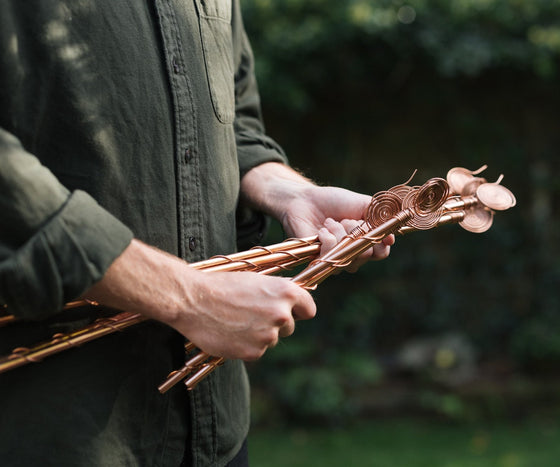
From a French market stall to a fibre-optic giant near Moscow, with a Czech razor device and an Indian architectural tradition along the way: the story of pyramid energy is one of people repeatedly rediscovering the same shape and going on to experiment with it themselves. Want that shape in your own home too? Check out Kopero's copper pyramid energiser, in smooth or twisted versions, or combine it with the tensor ring. Browse the full collection for more copper energy objects.