Copper or stainless steel tongue scraper: what is the difference?
Copper, stainless steel or plastic: where tongue scrapers really differ, what the Ayurvedic tradition says about it, and what to look at when choosing.
Written and source-checked by the Kopero editors · Updated September 5, 2026

Three materials, one movement
A tongue scraper does one thing: it takes off the coating that has formed on your tongue overnight. Whether that works depends mostly on the shape and on whether you actually pick it up every morning. Even so, the material is not an arbitrary choice, because copper, stainless steel and plastic all behave differently in a bathroom.
In short
- The Ayurvedic tradition prescribes metal, and copper is named specifically.
- Copper is naturally antibacterial; stainless steel and plastic are not.
- Copper tarnishes and wants occasional polishing, and with lemon and salt (not too hard: salt is mildly abrasive and dissolves well in the lemon juice) that is quickly done.
- Plastic is the cheapest option and the only one you throw away after a year.
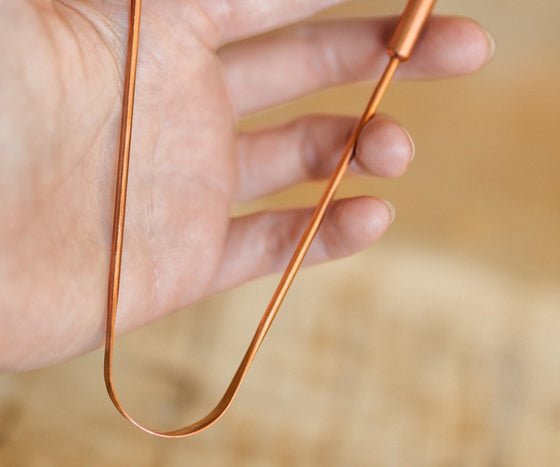
- Shape counts for more than material: a U-bend wide enough to cross your tongue.
- Ours is solid copper with no coating, bent by hand in India.
What the tradition prescribes
Scraping the tongue is known in Ayurveda as Jihva Prakshalana and is already described in the Charaka Samhita, one of the foundational texts. The classical instruction is about metal, and copper is named there alongside gold, silver and tin. Where the ritual comes from and how it is traditionally done is in the Ayurvedic morning ritual.
Stainless steel does not appear in those texts, for the simple reason that it did not exist until the twentieth century. Anyone who wants to follow the tradition as it was written down ends up with copper.
Copper in practice
Copper is a soft metal, which means the bend can be shaped by hand in the workshop and the edge does not feel sharp. It conducts heat quickly, so the scraper feels cool when you pick it up.
On top of that comes a property the other two materials do not have. Cleaned copper killed more than 99.9% of bacteria such as MRSA and E. coli within two hours in laboratory tests, and since 2008 it has been registered with the US EPA as an antimicrobial material. For an object that sits on a damp bathroom shelf between one morning and the next, that is not a detail. What exactly has been measured is in can copper really kill bacteria.
Copper does tarnish: after a few weeks the surface is duller and darker. That discolouration is patina and it is not harmful. You rinse the scraper after use, let it dry and polish it now and then with lemon and salt (not too hard: salt is mildly abrasive and dissolves well in the lemon juice). What discolouration does and does not mean is in why copper turns green or black.
Stainless steel and plastic
Stainless steel is harder than copper. That makes the scraper stiffer and the edge firmer, which some people like and others do not. There is hardly any upkeep: rinse it and you are done. Two things stand against that. Stainless steel is inert, so it does nothing against bacteria by itself, and it has no connection at all to the tradition the ritual comes from.
Plastic scrapers are the cheapest and the lightest. They are also the least durable: the edge wears, the material discolours in a bathroom, and in time you throw it out and buy another. How the three materials compare more broadly is in copper vs. plastic vs. stainless steel.
What to look at when choosing
Look at the width of the bend first. A scraper that is too narrow only takes off one strip of your tongue and then you have to reposition it three times. Then look at the handles: they need to sit far enough apart to hold with two hands without your knuckles reaching your chin.
With copper there is a third point: whether it is really solid copper or just a copper-coloured layer over something else. How to establish that is in how to recognise real copper.
How to use it
In the morning, before brushing your teeth and before drinking. You place the bend as far back on your tongue as is comfortable, draw it forward in one movement, rinse it and repeat a few times. Then rinse it off and leave it to dry.
Have a look at the copper tongue scraper, or browse the full range.