The Ayurvedic tongue scraper: a centuries-old morning ritual
Jihva Prakshalana comes from the Charaka Samhita and has been part of the morning for centuries. Discover why, and why copper is the traditional choice.
Written and source-checked by the Kopero editors · Updated August 20, 2026

In short
- Tongue cleaning (Jihva Prakshalana) is already described in the Charaka Samhita, one of the foundational Ayurvedic texts.
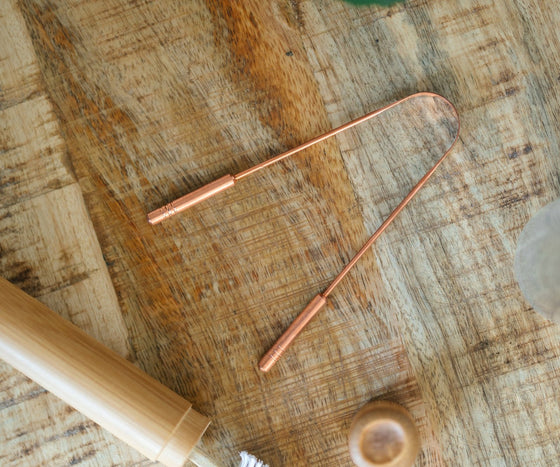
- The classical text prescribes scrapers made of gold, silver, copper, tin or brass: curved in shape and without sharp edges.
- Traditional Chinese Medicine also has centuries-old tongue diagnostics, used as a tool to say something about the health of the internal organs.
- A Cochrane review confirms that tongue scraping reduces, in the short term, the sulphur compounds that cause bad breath.
- In a clinical comparison, a tongue scraper removed 75% of those sulphur compounds, versus 45% with a toothbrush (Journal of Periodontology, 2004).
- Copper stands in the classical text alongside gold, silver and tin, and is the only one of the four that stayed in ordinary households through the centuries.
Jihva Prakshalana: cleaning the tongue
In the Charaka Samhita, one of the foundational Ayurvedic texts, tongue cleaning is already described as a fixed part of the morning, alongside cleaning the teeth and oil pulling. The fifth chapter of the Sutrasthana describes exactly what such a scraper should look like: made of gold, silver, copper, tin or brass, curved in shape and without sharp edges. Jihva Prakshalana, as the ritual is called, has been part of the morning for centuries.
Why first thing, even before you eat or drink
The classical text also immediately gives a very practical reason: the coating that builds up at the root of the tongue overnight is said to hinder breathing and cause an unpleasant smell. That's why the tongue should be scraped regularly, preferably as the very first action of the day.
That old insight holds up well, by the way. Modern dental research, including a review study by the Cochrane organisation, shows that tongue scraping genuinely reduces, in the short term, the sulphur compounds responsible for bad breath. The size of that difference was measured in the Journal of Periodontology (2004): a tongue scraper removed 75% of those sulphur compounds, a toothbrush 45%.
The tongue as a window: a view from Chinese medicine
Ayurveda isn't the only tradition that pays attention to the tongue. Within Traditional Chinese Medicine (TCM) too, the tongue has been used for centuries to say something about the health of the internal organs: its colour, shape, texture and coating are said to give clues about, for example, the liver, the spleen or the stomach. TCM practitioners look at the tongue in almost every consultation, alongside pulse diagnosis and other observations.
Two traditions that arose thousands of kilometres apart both place great value, then, on that same muscle in your mouth, both as a source of information and as a place to clean daily. We mention TCM here as interesting additional historical and cultural context alongside the Ayurvedic tradition, not as a replacement for it.
Copper, alongside gold, silver and tin
Read a little further in the classical Ayurvedic texts and you see that the Charaka Samhita names copper alongside gold, silver, tin and brass. Of that list, copper is the material that carried the ritual through the centuries: gold and silver were for temples, copper was for households. It is also the only one on that list still made for everyday use today.
That's exactly what makes choosing copper so comfortably approachable: you're not choosing an isolated miracle cure, but a material with a long, shared history within a ritual that has itself been around for centuries.
How to turn it into a calm morning ritual
Stick your tongue out gently and place the rounded side of the scraper as far back as feels comfortable. Draw it forward with light, even pressure. Rinse the scraper and repeat this two or three times. Pressing harder doesn't make the ritual better; a calm motion without pain or irritation is exactly the point.
After use, rinse the copper scraper clean, dry it and store it in a dry place. You can read the classical choice of materials for yourself in the Charaka Samhita on Dinacharya. By doing the ritual at the same moment every morning, it stops being a separate action and becomes a natural start to the day.
A small, fixed moment at the start of your day
Two or three calm strokes from back to front over the tongue, before you make coffee or brush your teeth, and you begin your day the way people have for centuries: mindfully, and with a fresh feeling in your mouth.
Curious how that feels? Check out Kopero's copper tongue scraper, or browse Kopero's full collection.