Tamra jal in practice: how much, how long and in which vessel
The ritual translated into an ordinary week: how long the water sits, which vessel suits what, and what you do when you are away from home.

From the source text to a Tuesday morning
Where tamra jal comes from and what the Sushruta Samhita says about it, you can read in Tamra jal. This piece covers the other half: how you translate that into a week in which you also have to work and do the shopping.
In short
- Four to eight hours is the usual window; overnight is the easiest to remember.
- We do not leave it standing longer than a day.
- Still water only. No lemon, no fizz, no tea left to sit.
- For the ritual the vessel does not matter; for your routine it does.
- Consistency counts for more than an exact number of glasses.
How long do you leave it?
The classical texts give no clock time. What they say is that the water rests in the vessel, and in practice four to eight hours is the window people work with. A night falls neatly inside it and has the great advantage that you never have to think about it: you fill before bed and drink when you get up.
We do not leave it longer than twenty-four hours. If the water smells or tastes different from usual, pour it away and clean the vessel with lemon and salt before you refill. How often a day is customary in this tradition is covered in how often a day.
Which vessel for what
For the ritual the shape is irrelevant: it is about water resting in copper. For your day it matters a great deal.
The 300 millilitre cup is the most direct form: no lid, about a glass, fits on a bedside table. You fill it, put a small saucer on top against dust if you like, and drink it in the morning before you do anything else.
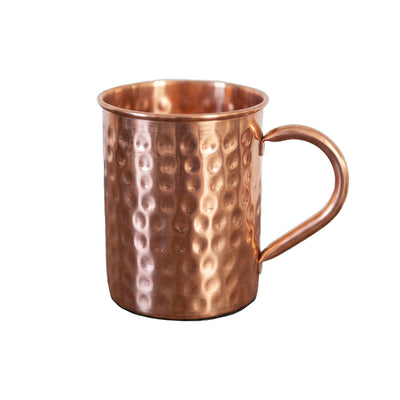
The 400 millilitre mug does the same thing but sits on your desk during the day, where it then serves for tea or coffee. What may go in it and what may not is in coffee and tea from a copper mug.
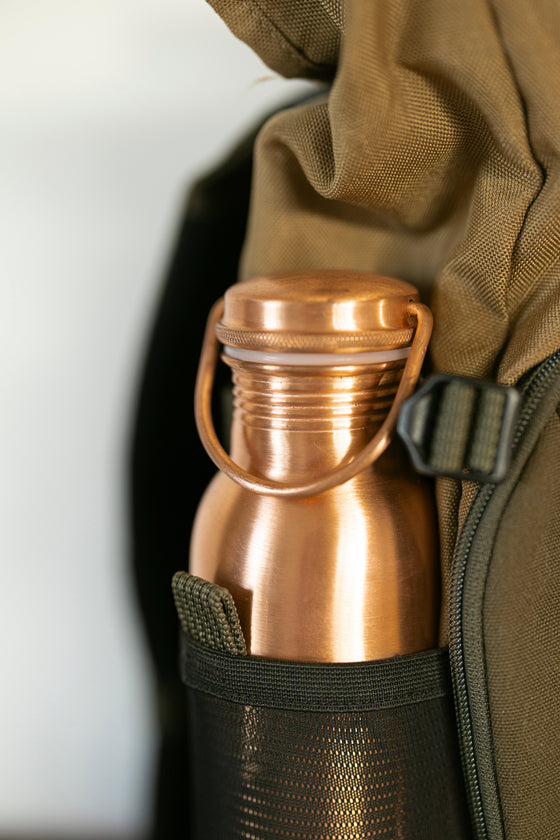
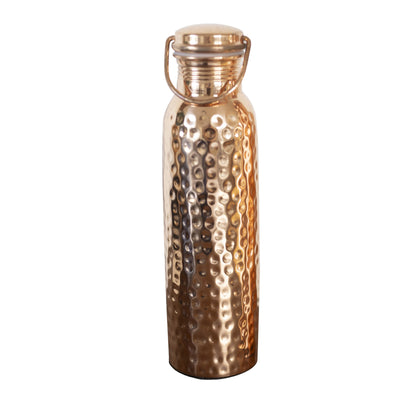
The 900 millilitre bottle is the only one that comes out of the door with you. Fill it in the evening, drink your first glass from it in the morning and take the rest along.
The 1.4 litre carafe is the only one that works for more than one person. Fill it, lid on, and the next morning you pour for everyone at once. Which size suits your day is in which size copper bottle.
An ordinary week
The simplest rhythm is this. In the evening, just before bed, you set out the vessel with fresh still water. The next morning you drink it first, on an empty stomach, before the coffee arrives. Then you rinse the vessel with warm water and leave it open to dry. In the evening you fill it again.
That is all. No scales, no plan on the fridge. Anyone who keeps it up for a week does not need one afterwards, because it hangs on brushing your teeth.
What does not belong in it
Still water, nothing else. Lemon water, lemonade, anything carbonated, iced tea and very acidic fruit teas attack uncoated copper and do not belong in a vessel where something sits for hours. Warm tea or black coffee can go in the mug, but to be drunk, not to be left.
When you are away
Travelling, the same principle holds: fill the bottle in your hotel room in the evening and drink in the morning. If the local water is not reliable, use bottled water; copper is not a treatment and does not replace a filter.
Skip a few days and nothing has happened. The ritual is a habit, not a course of treatment, and you pick it up where you left off.
It discolours along the way
That is part of it and says nothing about hygiene. Rinse daily and dry; polish when you want the shine back. Which product works for that and which one damages your copper is in cleaning copper.
Have a look at the full range to see which vessel suits your morning.