

A lovely product with a nice pouch

Samuel
Verified purchase
SHOP WITH CONFIDENCE 30 days to decide, money back if in doubt
FAST DELIVERY Order before 11:30 pm, usually delivered in 4-5 days


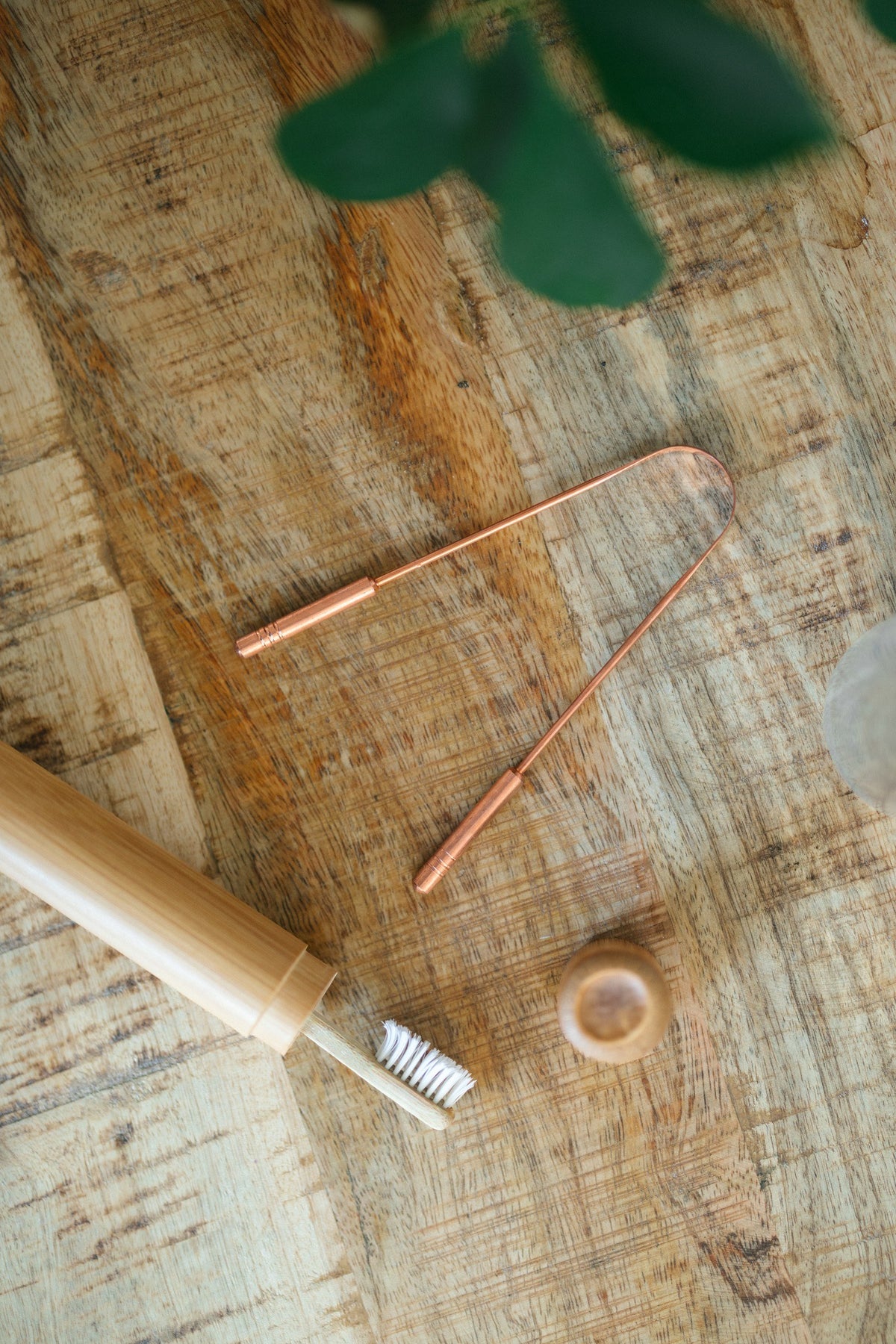
A simple material, curved to the classic shape with no sharp edge.
Tongue cleaning is a fixed part of the morning routine in Ayurveda, already described in the classical Charaka Samhita.
In studies, a tongue scraper removed 75 % of the sulphur compounds that contribute to less fresh breath, compared to 45 % with a toothbrush.
Like a toothbrush, you use the scraper only yourself, never shared with others.
Solid copper changes colour a little on its own over time. That's completely normal, and even a sign of pure copper. If you prefer the shine, simply polish the scraper with lemon and salt (not too hard: salt is mildly abrasive and dissolves well in the lemon juice). Exactly how is in the care guide.

The material is analysed by RTC Laboratory in Moradabad, a NABL-accredited lab, tested to ASTM-1621 and IS-228. In the sample that was analysed the measurement came out at 99.21% copper and 0.75% zinc; the remaining 0.04% falls within the measuring range of the analysis. Food safety is covered by a second report, from URS Products and Testing: tested against EC 1935/2004 and REACH, using the heavy metal limits from EU 10/2011 as the benchmark.


The tongue scraper is a small curved instrument you draw across your tongue in the morning, before you eat, drink or brush your teeth. That is when the coating is still there. It is one of the oldest parts of the Ayurvedic morning routine, and where that comes from is in the article on Jihva Prakshalana.
The shape does the work. You hold it at both ends, place it as far back as feels comfortable and pull it forward in one steady stroke, three to five times. The curve follows the width of your tongue and the edges are rounded, exactly as the Charaka Samhita prescribed: curved and not sharp.
For the movement itself the material matters little; after that, copper and stainless steel part ways. Copper is naturally antibacterial, and it is the metal the classical text names outright; stainless steel did not yet exist. Copper or stainless steel tongue scraper puts the two side by side.
Light pressure is enough. Stop if you feel pain or irritation or have any sores, and do not use the scraper on a damaged or inflamed tongue.
Rinse it under the tap after every use and dry it straight away. If it goes dull, a slice of lemon with salt (not too hard: salt is mildly abrasive and dissolves well in the lemon juice) brings the shine back; the other options are in cleaning copper. Otherwise do not share it, no more than you would a toothbrush.
And it discolours. Uncoated copper reacts to air and moisture and turns darker. It polishes back, and it is at the same time the best proof that there is no lacquer over it: a coated scraper would never discolour. What discolouration does and does not mean is in why is my copper turning green or black.
A small daily moment, just before you brush your teeth.

Polish it with lemon and salt (not too hard: salt is mildly abrasive and dissolves well in the lemon juice), rinse with warm water and dry it.

Scrape before you eat, drink or brush your teeth: the coating is still there then.

Hold it by both ends and place it as far back as is comfortable, no further.

Pull it forward three to five times, rinsing the scraper in between. Then rinse your mouth.

Light pressure is enough. Stop if it hurts, irritates or causes sores; do not use it on a damaged tongue.

Rinse under warm water, dry and keep it in the velvet pouch.
The packaging also carries a QR code that takes you straight to this guide.
The simple curved shape combines a grip, a gentle working edge and solid copper in one everyday tool.

The scraper is handmade in India from solid copper.
The classic curve allows a smooth motion from back to front, with no sharp edge.
The ribbed ends help distribute pressure evenly while scraping.
The curved shape matches the classic Ayurvedic description of daily tongue cleaning, often as the first step of the morning routine.
The tongue scraper comes in an elegant velvet pouch, together with a scannable guide.
You unpack a luxury black branded box. So you can give it away straight from the box, without wrapping anything around it.
A Kopero card is inside the box. The QR code on it takes you to the digital manual.
The first thing in your morning
The classic curve, in the copper the Charaka Samhita names
Handmade from solid copper
Two ribbed handles, control with both hands
That is all the time it takes
Velvet pouch for storing and carrying
Bacteria killed in lab tests, within two hours
Polish it back, and melting copper down costs it nothing

A piece of curved copper, nothing else. The design has stayed the same for centuries because it's worked for centuries, and it's changed very little in all that time.

The tongue scraper belongs to the same morning ritual as your toothbrush: scrape first, then brush. Rinse it after use and let it dry.
Unpack it at your own pace, feel the weight and see whether the size suits you. If it is not for you, send it back within thirty days and get your money back. If you use it for longer than you need to judge it, we may deduct for loss of value. You arrange the return yourself with whichever carrier suits you best, or you ask us for a return label. The cost of sending it back is yours.
Read the return policyTranslated from Dutch
A lovely product with a nice pouch
Good quality tongue scraper!

A lovely ritual every morning. Happy with it

I scrape my tongue every morning. Feels fresh

Handy

A lovely product

Comes with a handy storage pouch

First thing in the morning, before you eat, drink or brush your teeth. That way, the coating that builds up on the tongue overnight is still there, and you remove it before it spreads further through the mouth.
It shouldn't be painful. Place the scraper as far back as feels comfortable, pull it forward in one smooth stroke with light pressure, and repeat three to five times. Stop if you feel pain, irritation or small nicks, and don't use the scraper on an injured or inflamed tongue.
No, only use the scraper yourself. Just like a toothbrush, it's a personal care item.
Jihva Prakshalana is the Ayurvedic term for tongue cleaning, already described in the Charaka Samhita as a fixed part of the morning routine alongside cleaning teeth and oil pulling. This classical text mentions scrapers made from gold, silver and copper among others, with the only requirement being that they're curved and not sharp. In modern research, a tongue scraper removed 75% of the sulphur compounds that contribute to less fresh breath, compared to 45% with a toothbrush.
Rinse it under warm water after every use, dry it thoroughly, and store it dry in the velvet pouch. Polish it with lemon and salt (not too hard: salt is mildly abrasive and dissolves well in the lemon juice) every now and then if you want the shine back: discolouration on solid copper is completely normal. Step by step instructions are in the care guide.
Clean your tongue, then have your morning water. Two products for one everyday routine.

