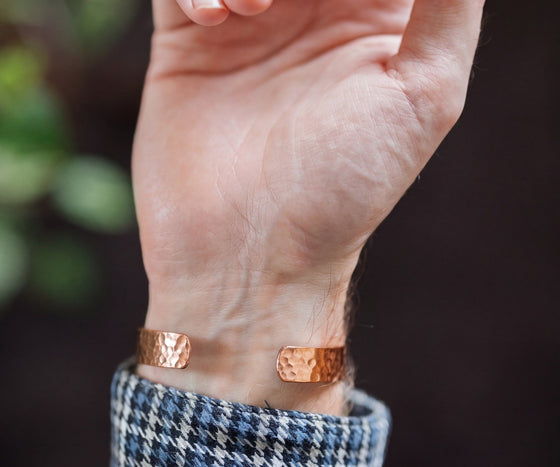
Copper bracelet with or without magnets: which do you choose?
Many copper bracelets have small magnets in the ends. Where did that come from, what has been studied about it, and why is there no magnet in ours?
Written and source-checked by the Kopero editors · Updated September 5, 2026

Two traditions that got tangled together
Search for a copper bracelet and you quickly meet models with small magnets in the ends. Copper and magnet are often named in the same breath, as though they belong together. Historically they do not: they are two separate traditions that only found each other in the twentieth century.
In short
- The copper bracelet is centuries old; the magnetic bracelet is a modern addition.
- Both were studied in the twentieth century. What came out of that is in our article on the bracelet.
- Our bracelets are pure copper with no magnets, no nickel and no coating.
- What has been measured about copper on the skin is in our article on the bracelet; health claims we do not make.
- If you wear a pacemaker or another implant, a magnetic bracelet is something to discuss with your doctor in any case.
Where the copper bracelet comes from
Copper on the wrist turns up in Egyptian and Greek sources, in Ayurveda and, much later, on the western market. The practice is old, then, and in the twentieth century it was also studied seriously a few times. What those studies did and did not show is in the copper bracelet: a centuries-old tradition.
Where the magnet comes from
The magnetic bracelet comes from somewhere else: modern magnet therapy, which became commercially popular from the 1970s on. Manufacturers combined the two at some point, because both are jewellery you wear on your wrist and because together it sounds like more than either alone. A shared history they do not have.
Why our bracelets have no magnets
We make one thing: solid copper. A magnet in the ends means a second material, a glued joint and a place where dirt collects. It also means the bracelet is no longer entirely one metal, which is precisely what the tradition is about. More has also been measured about copper on the skin than about magnets, and that is exactly the reason to keep it to that one material.
What may officially be said in the EU about copper is in the eight official EU claims.
What to look at instead
Look at the purity of the copper. Many cheap bracelets are brass or copper-plated steel with a lacquer over the top, and that layer comes loose after a few months. How to recognise real copper is in the complete buying guide.
Then look at nickel. Nickel is the most common cause of contact allergy in jewellery. Ours does not contain it.
And look at the fit. An open, adjustable bracelet fits far more wrist sizes than a closed model, and you can bend it to shape yourself. Ours has a circumference of about 17.5 centimetres and comes in four finishes: twisted, smooth, hammered and round.
The green mark
On many wearers, copper leaves a faint green mark on the skin after a while. That is a reaction between copper, sweat and skin oils, and it washes off with water. What it does and does not mean is in why copper turns green or black.
Have a look at the copper bracelet in its four finishes, or browse the full range.