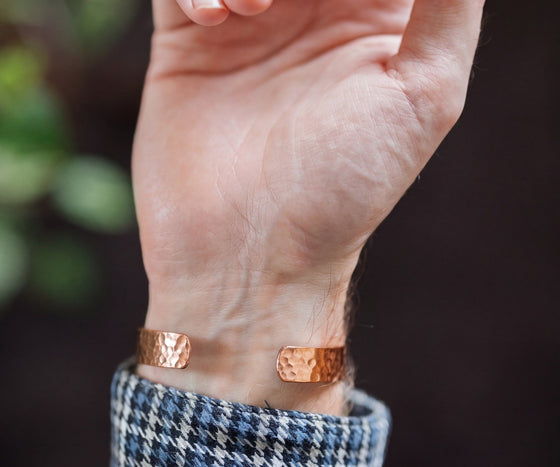
The copper bracelet: a centuries-old tradition
People all over the world have worn copper bracelets since the 19th century. Discover the rich history and the stories from wearers themselves.
Written and source-checked by the Kopero editors · Updated August 20, 2026

In short
- Archaeologists have found a copper ornament dating back to around 8700 BC in northern Iraq.
- The copper bracelet appears independently in traditions all over the world: among the ancient Egyptians, indigenous peoples around the Great Lakes, and the Celts.
- From the nineteenth century onward, metallotherapy emerged in Europe, with the copper bracelet as its best-known example.
- Within the chakra system, copper is associated with the Heart Chakra and "grounding" the aura.
- The oldest clinical bracelet study (1976) measured an average of 13 milligrams of copper released to the skin per month; dermatological research confirmed that copper penetrates the upper skin layer.
- The copper peptide GHK-Cu has been scientifically studied and, when applied topically to the skin, has been shown to stimulate collagen and elastin production.
- Copper is a living material. Every bracelet develops its own unique patina over time.
One of the oldest pieces of jewellery humans ever wore
Even before written language existed, humans were already wearing copper on their wrists. Archaeologists found a copper ornament in northern Iraq dating back to around 8700 BC. What began as a practical, workable metal grew into something people worldwide have worn on their wrists for thousands of years, as jewellery, as a status symbol, and for many people also as something that simply makes them feel better.
A tradition that keeps appearing everywhere
What stands out about the history of the copper bracelet is that it doesn't come from a single culture. In places thousands of kilometres apart, with no contact between those peoples, copper kept acquiring a similar, special meaning again and again.
In ancient Egypt, copper was associated with the goddess Hathor, goddess of love and fertility, whose sanctuaries were located, among other places, near the Sinai, where the Egyptians mined copper. Priestesses reportedly wore copper during ceremonies dedicated to Hathor, and copper amulets were placed in graves in the belief that they offered the soul protection on its journey through the afterlife. This is a religious tradition from ancient Egypt that is still passed down today.
Around the Great Lakes in North America, indigenous communities were already mining pure copper directly from the ground thousands of years ago. In the traditions of various Native American peoples, copper was regarded as a sacred gift from the earth, worked into talismans and passed down with care. This too is a cultural tradition, carried by stories handed down from generation to generation.
Among the Celts in Europe, copper was anything but a random choice of jewellery. Copper and bronze torcs, sturdy, open rings worn around the neck or wrist, served as a status symbol and were worn by leaders and warriors. In Celtic tradition, wearing such jewellery also stood for spiritual power.
From French laboratories to today's streets
Around 1830, scientists discovered copper in human blood, and that finding set in motion a movement now known as metallotherapy: wearing metal objects on the body. French physician Victor Burq was one of the first to seriously investigate and describe this, and from the mid-nineteenth century onward the copper bracelet began a rise that continues to this day. In the 1970s, the bracelet gained a new wave of popularity, especially in Britain and the United States.
Chakras, aura and life energy
Within energetic and spiritual traditions, copper is still discussed in the language of energy. Within the chakra system, which has its roots in Indian traditions, copper is often associated with the Heart Chakra (Anahata), the energy centre linked in that tradition to connection and balance. Practitioners of energetic disciplines describe copper as a conductor of what they call life energy, and use it to help ground the aura.
Venus on your wrist
Within the Western esoteric tradition, copper is the metal of Venus. That link runs through Cyprus, the copper island where Aphrodite held a central place. She stood for love, beauty, attraction and fertility, and within the Cypriot tradition she was also linked to copper mining. Centuries later, Agrippa once again explicitly linked copper to Venus.
That gives a copper bracelet yet another meaning: not just grounding and conduction, but also connection, receptiveness and self-worth. Some wearers deliberately choose the left wrist as the receiving side and the right wrist as the giving or acting side. There's no universal rule; the value lies precisely in the intention you bring to wearing it.
The bridge to the skin: what science actually shows
Apart from these cultural and spiritual traditions, there's also a concrete scientific track, although that concerns a different kind of contact with copper than wearing a bracelet. In the early 1970s, American biochemist Loren Pickart discovered a copper peptide that occurs naturally in the body: GHK-Cu. A 2018 study, published in the journal Molecules by publisher MDPI, shows that GHK-Cu, when applied topically and cosmetically to the skin, can demonstrably stimulate the production of collagen and elastin.
That research concerns creams and other products in which the copper peptide is applied directly to the skin, not wearing a piece of copper jewellery. So it's not direct evidence for the effect of a bracelet. What it does show is that copper and the skin, down to the cellular level, appear to have been connected for longer than you might think.
Measured at the wrist: copper transfers to the skin
Direct measurements have also been taken on bracelets. In the oldest clinical study on copper bracelets (Walker and Keats, Australia, 1976), the bracelets were found to release an average of 13 milligrams of copper per month while worn, dissolved in sweat and absorbed through the skin. A significant share of the wearers in that study reported benefiting from wearing it. Dermatologists Hostynek and Maibach, who together wrote an entire book on the subject (Copper and the Skin, 2006), later confirmed in a study with volunteers that metallic copper genuinely penetrates the upper skin layer.
The newest branch of this research field is textiles with copper oxide worked into them. In a double-blind, placebo-controlled study, volunteers slept for four weeks on a pillowcase containing copper; their skin improved measurably compared with the placebo group. And in wound care, dressings containing copper sped up healing, even faster than silver dressings. Low doses of copper via the skin, exactly what a bracelet does day in, day out, are therefore being seriously researched, and the results keep the centuries-old habit remarkably good company.
What people say about it themselves
Anyone who looks around on social media sees that tradition still very much alive. Under videos about copper bracelets, you strikingly often see the same kind of comments: people saying they wear the bracelet for stiff joints, an annoying wrist, or the kind of tingling discomfort that comes with carpal tunnel syndrome. One person calls it relief for an old ankle injury, another says they now wear it every day and simply feel better for it.
That's also exactly why a copper bracelet feels so different from just any piece of jewellery. You're joining a habit that's been passed down in Europe since the nineteenth century, and that existed in other forms across multiple continents for centuries before that.
A simple wearing ritual
Before putting the bracelet on, hold it for a moment between both hands. Choose one quality you want to carry with you that day, such as calm, openness, creativity or courage, and link it to the copper in one short sentence. Then wear it without constantly thinking about it. At the end of the day, when you take it off, you can briefly look back: where was that quality noticeable?
That way, the bracelet becomes more than an object on your wrist. Its changing shine and patina start co-writing a personal ritual, not imposed from outside, but shaped by you through repetition.
A piece of jewellery that grows with you
There's another nice detail to wearing copper: no two bracelets age the same way. Copper responds to your own skin, your own warmth and sweat, and so develops a unique, personal shine or patina over time.
Want to experience that centuries-old tradition yourself? Check out Kopero's copper bracelet, or browse Kopero's full collection.