Sacred Cubit, Lost Cubit and New Cubit: the measurements behind the tensor ring
What do the Sacred Cubit, Lost Cubit and New Cubit mean, and why does the Kopero tensor ring have a 4-centimetre diameter? Discover the measurement behind the ring and everyday use.
Written and source-checked by the Kopero editors · Updated August 20, 2026

A tensor ring looks like a circle. Yet it doesn't start with its diameter, but with something you can barely see once it's closed: the length of the copper wire. Within the Light-Life tradition, that original length determines which cubit measurement the ring carries and which field it's connected to.
That's why makers don't just talk about big and small. They talk about the Sacred Cubit, the Lost Cubit and the New Cubit. Three measurements, each with its own history, resonance and place within Slim Spurling's lineage.
In short
- The Sacred Cubit is 20.6 inches, roughly 52.3 centimetres.
- The Lost Cubit is 23.49 inches, roughly 59.7 centimetres.
- The first Light-Life Ring was made in 1991 based on the Sacred Cubit.
- Hans Becker introduced the Lost Cubit within this tradition in 2000.
- The New Cubit was added in 2011 and is used for the Light-Life Empowerment Ring and other tools.
- Halves, quarters, eighths and multiples of a cubit are also shaped into rings.
- The total wire length before closing is the measurement. Diameter, twist and finish all follow from that.
- The Kopero tensor ring has a compact final diameter of 4 centimetres and is made for use around the tap, next to water, or as a personal ritual object.
The ring starts as a straight length
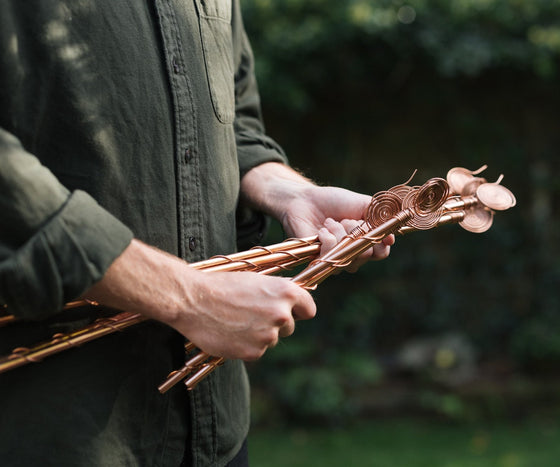
Picture a piece of copper wire still lying straight on a workbench. The maker first measures out the desired cubit, or a fraction of one. The wire can then be twisted, folded, re-twisted or hammered. Only at the very end are the ends brought together, forming the closed circle.
That explains why two tensor rings with a similar diameter can still be different. A single strand, a twisted pair and a double-twisted strand don't use the same amount of metal. Within the tensor tradition, then, it's not just the visible outer size that matters. The complete route from straight wire to closed shape counts too.
The Sacred Cubit: the measurement of the first Light-Life Ring
The Sacred Cubit measures 20.6 inches, about 52.3 centimetres. According to the official Light-Life archive, Slim Spurling used this measurement for the first Light-Life Ring. That was made in 1991, when Spurling and Bill Reid brought together their ideas about copper wire, resonance and geometry.
Within this lineage, the Sacred Cubit is linked to a resonance of 144 MHz. The ring is said to form a tensor field, or "neutral space", around its open centre. Users often describe the Sacred Cubit as broad, harmonising and pleasant for everyday use around water, plants, spaces and personal objects.
The name refers to the ancient cubit as a unit of measurement, but the specific measurement of 20.6 inches belongs to the modern Light-Life tradition. It's precisely that combination that makes it interesting: an age-old way of measuring gained a new energetic application in Spurling's workshop.
The Lost Cubit: the measurement that returned in 2000
The Lost Cubit is longer: 23.49 inches, about 59.7 centimetres. Hans Becker, a researcher and inventor who worked closely with Spurling, introduced this measurement in 2000. Within the tradition, it's linked to 177 MHz and to a more focused, more intense field.
The US application Rings and Harmonizer, published in 2009, describes both the Sacred and the Lost Cubit. The document mentions rings of a full cubit, but also multiples and fractions. It also describes how a Sacred Cubit ring and a Lost Cubit ring can be placed inside one another in a harmonizer.
So the Lost Cubit isn't a larger version of the same idea. Within Light-Life, it has its own field quality and is used for different emphases. Some practitioners choose it when they want to work more powerfully with intention, space or water.
The New Cubit: the third part of the cubit trinity
In 2011, the New Cubit was added. The official Light-Life archive calls it the final part of a trinity: Sacred, Lost and New. This measurement is used, among other things, for the Light-Life Empowerment Ring.
The New Cubit emerged after years of further work with the existing tools. Within the lineage, it stands for development. The tradition didn't stand still after Spurling's first ring, but grew along with new experiences from makers and users. That gives the New Cubit a different place than the two older measurements: it's not a rediscovered historical cubit, but a later addition to the living system.
Why fractions matter just as much
A full cubit produces a fairly large ring. For a ring around a finger, a tap or a smaller object, fractions are therefore used, for example half, a quarter or an eighth of a cubit. According to the application, such sub-measurements remain part of the same geometric family. The ratio is preserved, while the physical ring becomes suited to a different application.
This is comparable to a musical note recurring in a higher or lower octave. The pitch changes, but the underlying ratio stays recognisable. Within cubit thinking, a fraction is viewed in a similar way: smaller in size, related in resonance.
Why the Kopero tensor ring is 4 centimetres
The Kopero copper tensor ring has a diameter of 4 centimetres. That's the visible final size of the closed ring, not the cubit length itself. The energetic measurement is determined earlier, when the maker measures out a fraction of the Sacred Cubit in copper and then closes that length into a loop.
For comparison: if you bend the full Sacred Cubit of about 52.3 centimetres into a simple circle, you get a ring roughly 16.7 centimetres across. A size like that gives a more spacious working area, but doesn't fit practically around a normal kitchen tap. A compact cubit fraction brings the same measurement principle back to a shape you can use every day. Kopero's 4 centimetres gives enough open space to slide around virtually any standard kitchen tap while staying small enough to move around or take with you easily.
For water, you slide the ring onto the tap, just above the spout. The flowing water then moves through the open plane of the ring without touching the copper. Within the tensor tradition, it's precisely that open centre that's seen as the active tensor plane. You can then use the water for drinking, cooking or caring for plants. The ring doesn't remove substances the way a water filter does, but it can be used alongside one when you want to combine purification with energetic structuring.
The same ring can also sit loose next to a copper water bottle, a glass or a jug. You can hold it in your hand during meditation, place it on your desk, or put a small personal object inside its open centre. The 4-centimetre size keeps the field local and manageable: intended for one stream of water, one object or one clear intention at a time.
Twist, closure and the tensor plane
The length is the starting point. The construction determines how that length takes shape. Light-Life documentation mentions single and double-twisted wires, as well as hammered and flattened versions. Within the tradition, a double-twisted or hammered strand is used to strengthen the field and make it more coherent.
The closure is essential too. As soon as the ends form a continuous loop, a field is said, according to the tensor model, to form in and around the open centre. That centre is called the tensor plane or the neutral space. An object doesn't need to touch the copper for this. It's placed in, next to, or within the field of the closed shape.
Why copper specifically
Copper draws, twists, bends, solders and hammers well. It's also one of the best electrical and thermal conductors there is. For Spurling, that wasn't just an isolated material fact, but a practical reason to make copper the carrier of his geometry. The application simply states that copper works well, optionally with a layer of gold or silver over it.
Within energy work, that conductivity takes on a broader meaning. Copper is seen as a metal that doesn't hold onto a frequency, intention or subtle movement, but passes it on. The cubit gives the measurement. The closed circle gives the shape. The copper gives the whole thing a physical carrier.
From measurement to everyday use
The world of cubits only really becomes understandable once you see how simple the use can be. The compact Kopero ring works around flowing water or one personal object. Within the Light-Life tradition, larger rings and harmonizers are also used around plants, spaces and multiple objects. The scale changes, but the starting point remains the combination of measured copper length and closed geometry.
You don't need to calculate frequencies for any of this. The maker has already built the wire length and construction into the shape. As a user, you work with placement, time and intention. That makes the tensor ring both precise and accessible at once: behind the simple circle lies a tradition of measurement, but the daily ritual stays small.
Further reading
- Light-Life Technology: official explanation of the Sacred, Lost and New Cubit
- Rings and Harmonizer: wire construction, cubit fractions and tensor plane
- Tensor rings: who was Slim Spurling and what did he claim?
Want to use this closed copper geometry in your own daily water ritual? Check out Kopero's copper tensor ring. Also read about torsion fields and the Source Field, or discover the full collection.