Tensor rings: who was Slim Spurling and what did he claim?
Discover who Slim Spurling was and how he made the first tensor ring in 1991, inspired by Wilhelm Reich and Nikola Tesla.

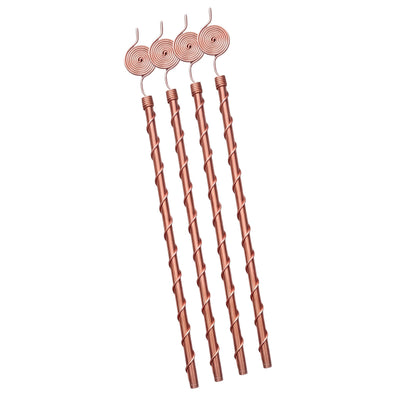
Kopero's tensor ring slides onto your tap, where it passively acts on the flowing water. You can also use it loose as an energy object, for example next to a water bottle or simply on a table. Behind that bent copper wire lies a story that begins with an American metalworker who saw the world differently than most people around him: Bill "Slim" Spurling.
In short
- Slim Spurling (1938-2007) bent the first "Light-Life Ring" from copper wire together with Bill Reid in 1991.
- The length of the ring is based on the "Sacred Cubit", a measurement of 20.6 inches that archaeocryptographer Carl Munck derived from ancient Egyptian structures.
- Spurling had his invention recorded in patent application US 2009/0040122 A1, "Rings and Harmonizer".
- His sources of inspiration were Wilhelm Reich and Nikola Tesla.
- Copper is the second-best conducting metal in the world after silver (about 5.96×10⁷ S/m), which explains why it keeps returning in energy traditions across the centuries.
- The idea that a physical treatment with no additives can change water has since become a serious field of research: from magnetically treated irrigation water in agriculture to measured pH changes in copper vessels.
- Orgonite uses the same copper coil shape, but cast in resin with quartz: a related belief with a different application.
From welder to inventor
Slim Spurling (1938-2007) worked with metal his whole life, without a lab coat or a university position. What drove him was a fascination with form, material and the ideas of two scientists who had occupied his mind for years: Wilhelm Reich and Nikola Tesla.
Reich, the Austrian-American psychoanalyst, had already experimented with metal decades earlier. In 1940 he built his first orgone accumulator, a cabinet built from layers of organic material and metal. Reich believed that certain metals, copper foremost, could attract energy and quickly bounce it back. Spurling carried that source of inspiration into his workshop.
1991: the first Light-Life Ring
The year it all came together was 1991. Together with his business partner Bill Reid, Spurling bent copper wire into a ring, but not just any length. He used a specific length formula, coming from a man named Carl Munck, and so the first "Light-Life Ring" was born. It was the beginning of what we now know as the tensor ring.
Spurling didn't stop at an idea. There's a published US patent application in his name, US 2009/0040122 A1, titled "Rings and Harmonizer".
The Sacred Cubit: an old measure, a modern claim
Carl Munck's length formula deserves its own story, because that's where the core of the mythology around the tensor ring lies. Munck called himself an archaeocryptographer and claimed to have discovered a worldwide geographic coordinate grid, hidden in the structures of ancient civilisations. Based on that, he derived the "Sacred Cubit": a length of 20.6 inches which, according to him, traces back to ancient Egyptian geometry and is said to be based on the circumference of the earth itself.
This is exactly the measurement Spurling used to bend his rings. The story got a sequel in the year 2000 when Hans Becker added an extra measurement to it, the so-called "Lost Cubit".
Sacred Cubit, Lost Cubit and New Cubit
Within the Light-Life lineage, it didn't stop at one measurement. The Sacred Cubit is the best known and is used for a broad, harmonising field. The Lost Cubit is linked within the same tradition to a different field quality and a more intense effect. Later, the New Cubit was added, again with its own length and application.
The important idea isn't just the diameter you end up seeing, but the total wire length before the ring is closed. Halves, quarters and other fractions of a cubit are also used. The official description of Light-Life Technology shows how closely measurement, winding direction, closure and shape are linked in this tradition. A tensor ring is therefore not a randomly bent piece of copper, but a geometric object built according to a specific lineage.
From jewellery to tap accessory
In Spurling's tradition, tensor rings are used in all kinds of forms: as jewellery, as a loose energy object, and, in the form Kopero sells, as a ring you slide onto a water tap. According to tensor principles, a closed copper loop creates a stable, ordering field around flowing water. Exactly the same property that makes the ring appealing as jewellery or an energy object is applied here to your everyday tap water.
Why copper
The choice of copper is no coincidence. Copper is the second-best conducting metal in the world after silver, with an electrical conductivity of about 5.96×10⁷ S/m. That's the reason copper has appeared for centuries in traditions working with energy and conduction.
Water turns out to be more sensitive to its surroundings than thought
The core idea behind the tensor ring, that you can change water without adding anything to it, sounds bold. Yet that very idea has become a serious field of research in recent years. In agricultural science, peer-reviewed studies have appeared on irrigation water that has passed through a magnetic field: seeds germinated 13 to more than 40% faster because of it, and several trials reported 20 to 25% higher yields. At the University of Washington, bioengineering professor Gerald Pollack describes how water forms an ordered, gel-like phase along certain surfaces that behaves differently from ordinary water; his work isn't uncontroversial, but it takes place in the laboratory and is publicly debated.
And that contact with copper itself measurably changes water has simply been measured: after sixteen hours in a copper vessel, the pH rose from 7.83 to 7.93 (Sudha et al., 2012). The tensor tradition uses a different means, geometry instead of magnets or vessels, but the underlying idea stands a good deal less alone than it did twenty years ago.
Orgonite: the same copper coil, a different application
Anyone who develops an eye for bent copper wire as an energy object soon runs into a related belief: orgonite. Orgonite typically consists of copper wire wound into coils and cast together with quartz crystals in resin, often with small metal shavings mixed in. The basis of this idea lies, again, with Wilhelm Reich, the same psychoanalyst who decades later also inspired Spurling. Reich introduced the term "orgone" to denote a universal life energy. The orgonite belief holds that the combination of copper coil, quartz and resin "transmutes" electromagnetic radiation (EMF) into this life energy.
As with the tensor ring, this is a claim that stems from Reich's own ideas about orgone energy. What orgonite and the tensor ring do share is the shape: a copper coil as the core element. Two different traditions, the same intuition about what bent copper might be able to do.
The Kopero blind water test
A tensor ring invites you to try it for yourself. Fill two identical glasses with the same tap water and have someone else treat one glass according to the tensor tradition, for example by placing it in or near the ring. Have that person label the glasses A and B, so you don't know which water was near the ring.
Taste both at the same temperature and immediately write down three things: taste, mouthfeel and aftertaste. Switch the order and repeat the test on several days. Many users describe treated water as softer or rounder; with a blind setup, you find out what your own senses actually tell you, without the answer being fixed in advance.
Further reading
Curious about other stories within the same belief system? Also read about pyramid energy, from a French trader to Russian fibre-optic giants, and about torsion fields and the story behind Kozyrev and Wilcock.
What began as the idea of a single metalworker in his workshop has grown into an object used all over the world: on a finger, on a table, or, as with Kopero, on a tap. Want to experience for yourself what a tensor ring does to your tap water? Check out Kopero's tensor ring, or discover the rest of the range in the full collection.