Copper vs. plastic vs. stainless steel: a fair material comparison
Plastic, stainless steel or copper: which material suits you? A fair comparison on antimicrobial properties, durability and tradition.

In short: copper vs. plastic vs. stainless steel
| Copper | Plastic | Stainless steel | |
|---|---|---|---|
| Antimicrobial | Naturally, EPA-registered since 2008 | No | No |
| Sustainability | Infinitely reusable, lasts generations | Fossil-based, barely breaks down in nature | Sturdy and usable for a long time |
| Feel and weight | Feels warm, develops its own patina | Light, but without character | Neutral, keeps looking the same |
| Maintenance | Occasional polishing for extra shine, otherwise minimal | Maintenance-free, but replaced when worn | Virtually maintenance-free |
Three materials, three very different stories
Walk into any shop selling water bottles and you'll come across roughly three materials: plastic, stainless steel and copper. All three do essentially the same job, but that's about where the similarity ends.
Plastic: light, cheap, and that's about it
Plastic is light, cheap and available everywhere. But it's a fossil-based product, barely breaks down in nature, and with long or repeated use, small pieces of microplastic can end up in the water. Plastic also has no surface that actively works against bacteria.
Stainless steel: durable and neutral, but without a story
Stainless steel is a big step up from plastic: it's sturdy, lasts a long time, and barely affects the taste of your water. What stainless steel lacks is character of its own. Where copper develops a lively, personal patina, stainless steel still looks virtually the same after years as it did on day one.
Copper: natural, antimicrobial, and with a history spanning thousands of years
Copper stands out on a few points that the other two materials simply don't have. To start, it's demonstrably antimicrobial: the US EPA officially registered copper alloys as an antimicrobial surface material in 2008, and research into drinking water in copper vessels shows that bacteria clearly thrive less well there than in plastic. It's also a purely natural metal, infinitely reusable without loss of quality.
On top of that, copper is simply the oldest metal humans ever consciously began working, with traces of use going back thousands of years. And where plastic yellows and stainless steel simply stays as it is, copper becomes more beautiful over time. It develops a unique patina that never unfolds the same way twice, small proof that the product has genuinely become yours.
Not just drinkware: the same comparison applies to every copper product
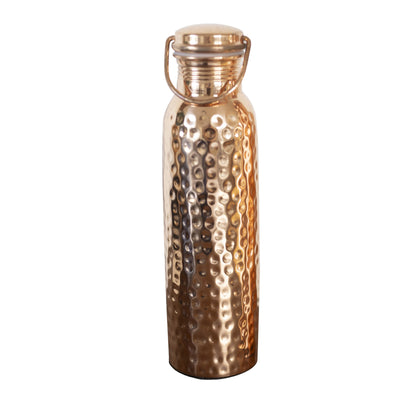
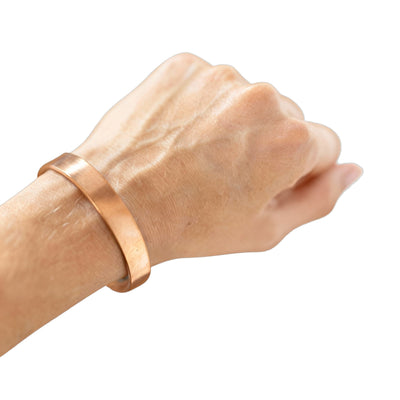
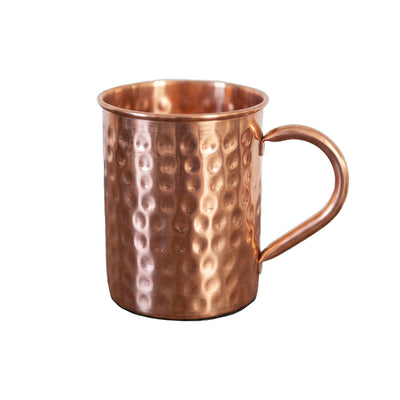
This comparison doesn't only apply to water bottles. It applies to every copper product you come into contact with. A copper mug or cup in the kitchen cupboard, a copper jug on the nightstand, a copper bracelet on your wrist, even a copper tongue scraper: the same properties are at play in each of those products. The same antimicrobial surface that sets a copper water bottle apart from a plastic one is also what makes a copper mug feel different from a stainless steel version. The same patina that makes a copper jug more beautiful over time shows up on a copper bracelet too.
Copper as a circular material
One of copper's strongest points only becomes visible once a product reaches the end of its first life. Copper can be melted down and used again without losing its characteristic material properties. That means the same metal can travel through different shapes and generations: from pipe or sheet to everyday object, and later into something new again.
The International Copper Association therefore describes copper as an important material for the circular economy. For everyday use, that means something very tangible: choose a product you'll keep for a long time, maintain it, let the patina become part of the story, and eventually hand the metal back in once it's genuinely no longer usable. Copper isn't a disposable material; it stays a raw material.
Which choice suits you?
If you're simply after the cheapest, lightest option, plastic is still available. If you want something solid and no-fuss, stainless steel is a sound, practical choice. But anyone looking for a material that naturally works against bacteria, that's infinitely reusable, and that carries a piece of history stretching back thousands of years, will naturally end up at copper.
Curious how copper feels in practice? Check out Kopero's copper water bottle, copper mug, copper cup, copper jug and copper bracelet, or browse the full collection.